
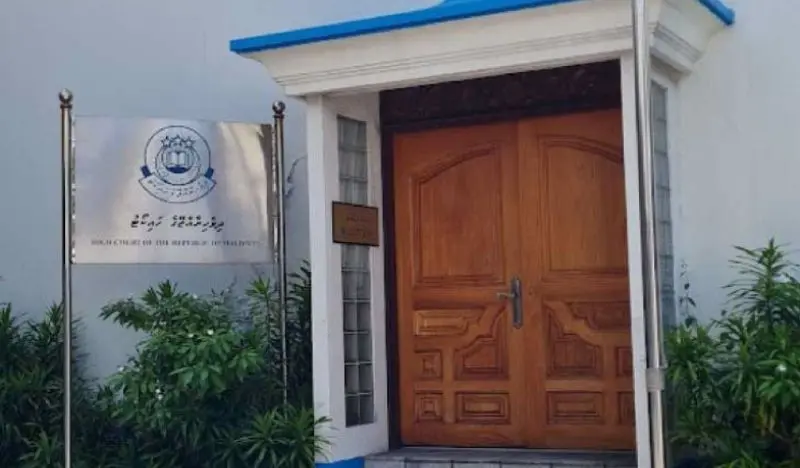
The High Court has upheld a Criminal Court ruling that President Dr Mohamed Muizzu does not need to be summoned as a defence witness in the Islamic defamation (qadhf) trial concerning a documentary produced by the news outlet Adhadhu. However, the appellate court overturned the lower court’s decision to bar co-accused Aishath Eesha Ashraf from testifying for the defence.
The case stems from qadhf charges brought against Adhadhu CEO Hussain Fiyaz Moosa and Editor Hassan Mohamed, alongside Eesha. During pre-trial hearings, which began behind closed doors last September, Fiyaz and Hassan sought to call President Muizzu, Eesha, and a criminal justice expert as defence witnesses. Following objections from state prosecutors, the Criminal Court declined to admit all three.


Fiyaz and Hassan appealed the decision to the High Court, though their legal team dropped the request to include the criminal justice expert midway through the proceedings, leaving the court to rule on the admissibility of President Muizzu and Eesha.
In its ruling delivered last Tuesday, the High Court unanimously affirmed the lower court’s refusal to summon the President, while a majority bench ruled that Eesha must be permitted to give evidence.
According to the appeal filings, Fiyaz and Hassan sought to summon President Muizzu to verify the authenticity of a formal complaint letter allegedly sent on his behalf to the police on 28 April, and to demonstrate from its contents that he had not personally watched the documentary in question. They also argued his testimony would help establish that the word “adultery” (zina) is never mentioned anywhere in the broadcast, contrary to the letter’s assertion that the video report falsely accused him of committing adultery.
Meanwhile, the defence sought to call Eesha, who also faces qadhf charges on the allegation that hers is the female voice heard in the documentary to demonstrate that the statements made in the video did not constitute an accusation of adultery, and to refute the charges brought against them.
The Criminal Court had originally rejected President Muizzu as a witness on the grounds that his letter was merely a request for a police investigation, and summoning him to refute claims he had already denied was unnecessary. Regarding Eesha, the lower court held that her personal interpretation of the documentary was irrelevant, noting that it is strictly up to the court to determine whether the broadcast legally amounts to an accusation of adultery.
In its review, the High Court observed that since the authenticity of the President’s letter is not currently in dispute, there is no need to summon him to verify it. The court further noted that as the complainant, the President does not determine the specific criminal charges filed by the state, and exploring his intent in requesting an investigation has no bearing on proving the legal elements of the charge.
Conversely, the High Court found that because the prosecution alleges Eesha is the speaker in the documentary, she is directly connected to the facts of the case. The court held that her testimony could assist in establishing key facts at trial, and excluding her risked obstructing the defendants’ right to mount a full defence.