
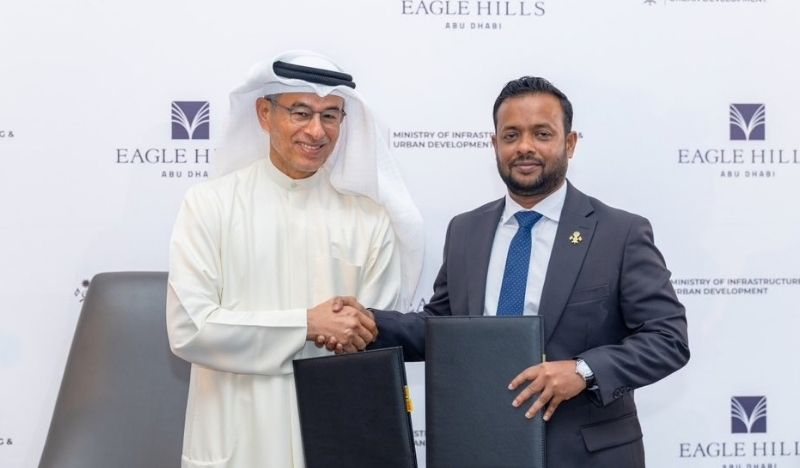
Minister of Infrastructure, Housing and Urban Development Dr Abdulla Muththalib has defended the government’s commercial agreement with UAE-based developer Eagle Hills for the Rasmalé development, rejecting several criticisms surrounding the terms of the 500-hectare project.
In a LinkedIn post titled “Given away for free and other things Rasmalé isn’t”, Dr Muththalib addressed four criticisms he said had been repeatedly raised in public discussions about the agreement.
The minister rejected claims that the Rasmalé site had been given away without payment. He compared the agreement with previous land and lagoon transactions, including the 2015 lease of Emboodhoo Lagoon for USD 40 million over 50 years and a 2023 agreement involving Foththeyo Lagoon, under which the developer was not required to make a monetary payment but was instead required to build a private airport.
Under the Rasmalé agreement, Dr Muththalib said Eagle Hills will finance and construct 5,000 three-bedroom housing units in Hulhumalé, with an estimated value of about USD 500 million. He said the financing would not involve state loans or sovereign guarantees.
However, Minister Muththalib, in an interview with online news outlet Mihaaru, separately described the arrangement as contractor-financed. Under that structure, Eagle Hills would initially finance construction and that the amount owed by the government for these flats will be deducted from the revenue generated by the Ras Malé project.
The government has not publicly detailed how much it would ultimately pay Eagle Hills for the 5,000 homes or how the payments would be structured over the course of the project.
The minister also said the state is expected to receive about USD 3 billion in land-related revenue over 10 years through a 10 per cent share of sales.
Addressing criticism of the revenue-sharing arrangement, Dr Muththalib argued that a revenue share would provide greater protection to the state than an equity stake in the development.
He referred to the government’s former minority shareholding in Shangri-La’s Villingili Resort in Addu, saying the resort operated at a loss for several years and that accumulated liabilities eroded the value of the state’s stake before it was sold in 2023.
According to the minister, a 10 per cent share of gross sales allows the state to receive revenue without assuming responsibility for the developer’s losses or cost overruns.
Dr Muththalib also sought to clarify the payment arrangements for the 5,000 housing units.
He said Maldivian families allocated the units would make payments directly to the government, with the terms of those payments determined solely by the state. Eagle Hills’ contractual role, he said, is limited to financing and constructing the housing units and does not include a direct contractual relationship with the households.
On concerns over sovereignty and foreign ownership, the minister said property transactions within Rasmalé, including resales and transfers as gifts, would require government approval and background checks.
He further said ownership of property would not automatically provide residency or visa rights, which would remain subject to decisions by the Maldivian government.
Dr Muththalib called on the public and political commentators to base discussions about the Rasmalé project on the terms contained in the agreement between the government and Eagle Hills.