

Maldives First Country to Eliminate Mother-to-Child Transmission of HIV, Syphilis and Hepatitis B
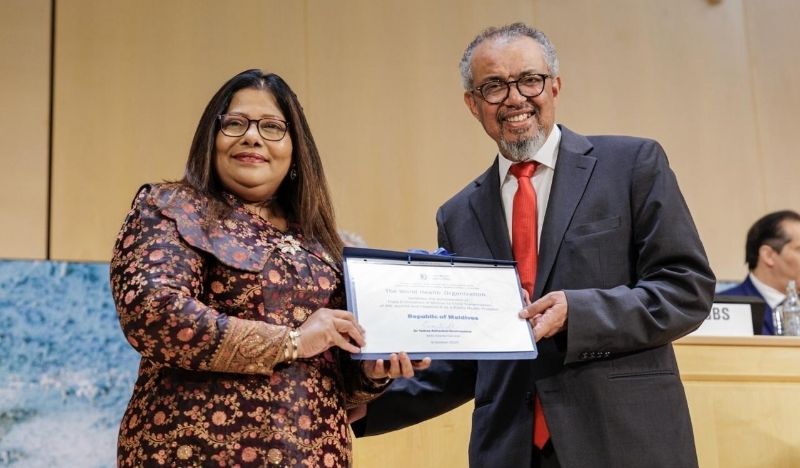
Minister of Health, Family and Welfare Geela Ali (L) accepting the World Health Organisation’s triple elimination certificate to the Maldives on May 29, 2026, at the Seventy Ninth World Health Assembly | Photo: WHO
The World Health Organisation (WHO) has recognised the Maldives as the first country to achieve triple elimination of mother-to-child transmission of HIV, syphilis and hepatitis B.
In a post recognising the achievement, WHO described it as a landmark public health accomplishment reflecting decades of commitment to maternal and child health in the Maldives.
advertisement

The certification was presented during the Seventy-Ninth World Health Assembly, where Minister of Health, Family and Welfare Geela Ali accepted the award on behalf of the Maldives.
In a post on X, Minister Geela said the certification reflected the government’s efforts to strengthen public health services.
Proud to receive WHO certification at #WHA79 confirming Maldives as the first country to achieve triple elimination of HIV, Syphilis & Hepatitis B.
A landmark reflecting HEP @MMuizzu’s strong leadership in strengthening public health. Grateful to our health workers & partners. https://t.co/VYixfvMlw1— Geela (@geelaali) May 19, 2026
“Proud to receive WHO certification at #WHA79 confirming Maldives as the first country to achieve triple elimination of HIV, Syphilis & Hepatitis B,” she said.
Triple Elimination Initiative
According to WHO, the triple elimination initiative was introduced as part of efforts to expand maternal and child health services to address vertical transmission of communicable diseases, including hepatitis B virus (HBV).
The initiative encourages countries to simultaneously work towards eliminating mother-to-child transmission of HIV, syphilis and hepatitis B through integrated healthcare services.
WHO states that essential services under the initiative include testing for HIV, syphilis and HBV during antenatal care, timely treatment for infected mothers, counselling services, safe delivery practices, follow-up care for exposed infants, hepatitis B birth-dose vaccination, optimal infant feeding and long-term care for affected mothers.
The organisation also stressed that success depends on cooperation between governments, healthcare workers, policy-makers, advocates and communities, while ensuring the protection of human rights for women, children and families affected by the diseases.
Geela Calls for Sustainable Health Financing
Speaking at the Seventy-Ninth World Health Assembly on behalf of member countries of the WHO South-East Asia Region, Minister Geela said equitable and sustainable financial support was necessary to ensure public health safety.
She said the current period of economic challenges and political tensions facing the global health system required stronger international cooperation.
The minister noted that despite these challenges, countries in the South-East Asia region had made significant progress in disease control, emergency preparedness and digital health.
Geela also highlighted regional efforts to reduce tobacco use among younger generations and advances made in disease elimination programmes.
She said South-East Asian countries were focused on three key priorities in reforming the global health system: proactive cooperation towards shared goals, strengthening evidence-based decision-making, and ensuring sustainable financial support for public health systems.
The minister further stressed the importance of strengthening international relations to address regional health challenges and said capable leadership at all levels of the WHO was essential to achieving progress.
Concluding her remarks, Geela called for greater unity and cooperation among countries to overcome global health challenges and deliver meaningful results.