
President Dr Mohamed Muizzu has called on the international community to provide the financial backing necessary for the Maldives to adapt to escalating climate risks, warning that vulnerable island nations should not be forced into crippling debt to survive a crisis they did little to cause.
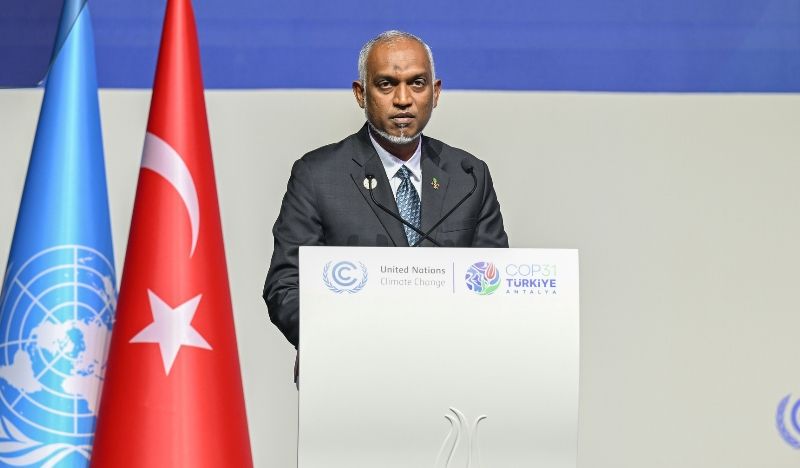
Delivering the Maldives’ National Statement at the 31st UN Climate Change Conference (COP31) in Antalya today, President Muizzu emphasised that as global temperatures push past the 1.5°C threshold, the Maldives remains resolute in building a resilient future, but requires urgent international cooperation across three core pillars: finance, systemic reform, and implementation.
advertisement

advertisement

Addressing the first priority, climate finance, the President urged developed nations to honour their longstanding commitments by ensuring support is new, additional, predictable, and grant-based. He called for the immediate replenishment of the Green Climate Fund, adequate capitalisation of the Adaptation Fund, and sufficient resourcing for the Loss and Damage Fund.
“Countries like the Maldives, which have contributed minimally to creating this climate crisis, cannot be expected to fall into debt simply to adapt to it,” President Muizzu stated, stressing that climate resilience must not come at the cost of an unsustainable debt burden.
Turning to his second priority, the President called for sweeping reforms to the global financial architecture to better account for the unique vulnerabilities of Small Island Developing States (SIDS). He urged international financial institutions and credit rating agencies to overhaul how they evaluate climate-related spending.
“Efforts towards resilience must be viewed as an investment in our collective future, not as a financial liability,” he told world leaders.
On his third priority, turning policy pledges into tangible action President Muizzu highlighted the Maldives’ domestic strides in strengthening food, water, and energy security despite limited resources. He noted that the nation is firmly on track to meet its renewable energy targets, pointing to recent government figures showing that installed renewable energy capacity has more than doubled since 2023, rising from 53 megawatts to 126 megawatts as the administration works toward its goal of generating 33 per cent of the country’s electricity from renewable sources.
The President also pointed to a major milestone in accessing global climate funds, noting that a Maldivian institution secured direct access accreditation to the Green Climate Fund last month.
“This is the first time a Small Island Developing State in Asia has achieved this,” President Muizzu said. “It demonstrates our institutional readiness to access and deliver climate finance effectively.”
Cautioning that unfulfilled ambitions amount to little more than empty promises, the President stressed that real progress requires concrete financing, technology transfer, and the political will to honour treaty obligations.
“We are calling for justice, accountability, and action,” he concluded, urging COP31 to prove that multilateralism can deliver meaningful results for nations on the front lines of climate change.