
Maldives has called for a strategic shift towards cultural tourism to diversify its world-renowned luxury travel sector and preserve its centuries-old heritage.
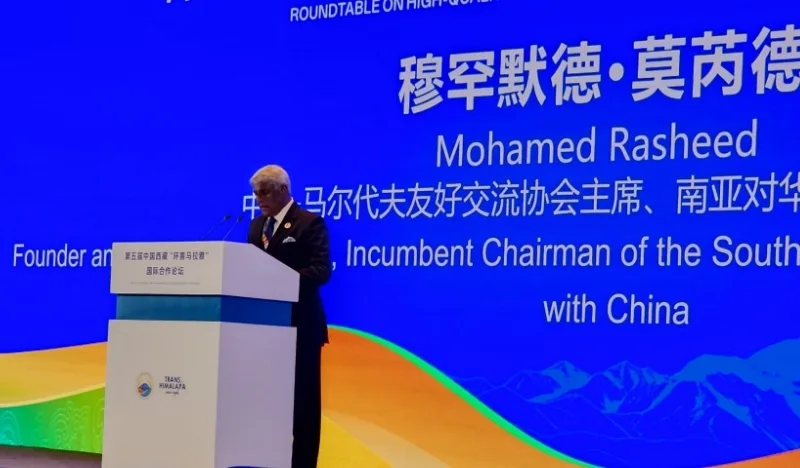
Speaking at the 5th Trans-Himalaya Forum for International Cooperation held in Nyingchi (Linzhi), Xizang Autonomous Region, China, Mohamed Rasheed, Founder and President of the China-Maldivian Cultural Association and incumbent Chairman of the South Asia Regional Friendship and Cooperation with China, emphasised that integrating cultural assets into the visitor experience is vital for sustainable regional growth.


While the Maldives is globally celebrated for its high-end resort tourism, pristine beaches, and marine biodiversity, Rasheed noted that the island nation possesses an intangible cultural heritage spanning over two millennia. Situated historically at the crossroads of major Indian Ocean maritime trade routes, the country developed a distinct identity shaped by diverse civilisations.
“Our traditional music, dance, language, craftsmanship, folklore, boat-building traditions, cuisine, oral histories, and community customs together represent a rich and vibrant heritage that deserves greater visibility on the global tourism stage,” Rasheed said.
Integrating these cultural elements into the broader tourism product would encourage visitors to travel beyond traditional isolated resorts and explore local island communities. According to Rasheed, this model creates direct economic avenues for cultural entrepreneurs, artisans, performers, and young people, whilst ensuring that living heritage is revitalised and transmitted to future generations.
Drawing a parallel between the mountainous terrain of the Himalayas and the low-lying coral islands of the Indian Ocean, the chairman stressed that both regions share a fundamental responsibility to safeguard the unique identities that define their societies. He highlighted international platforms like the Trans-Himalayan Forum as essential spaces for exchanging best practices in heritage conservation, research, and capacity building.
In his concluding remarks, Rasheed extended an invitation to Chinese investors and tourism enterprises to explore infrastructure, hospitality, and digital service opportunities across South Asia. Increased collaboration, he argued, would make the region more accessible to Chinese travellers while deepening bilateral friendship and people-to-people connectivity.
The 5th Trans-Himalaya Forum for International Cooperation, held from 16 to 19 July in Nyingchi (Linzhi), Xizang Autonomous Region, China, brought together senior government officials, policymakers, academics and business leaders from around the world to discuss sustainable development, ecological conservation, cultural exchange and regional connectivity. Participants included Vice President of Myanmar Daw Nan Ni Ni Aye, Pakistan’s Minister for Climate Change and Environmental Coordination, Dr Musadik Malik, Nepal’s Deputy Speaker of the House of Representatives, Rubi Kumari, as well as other senior Chinese government officials.