
The Government of the Maldives has welcomed a historic judgment by the International Court of Justice (ICJ) that found Myanmar responsible for committing genocide against the ethnic Rohingya population, marking the first time the United Nations’ top court has held a state directly culpable for the crime.
In a press release issued on Sunday, 22 November 2026, the Maldivian Attorney General’s Office hailed the court’s decision in The Gambia v. Myanmar case, delivered on Thursday, 19 November. The Hague-based tribunal determined that Myanmar’s security forces killed “thousands of Rohingya civilians” in northern Rakhine State, perpetrated widespread sexual violence, and inflicted “acts of extreme violence” against children. Judges further ruled that Naypyidaw failed in its legal obligations under the 1948 Genocide Convention to prevent and punish the atrocities.


The court ordered Myanmar to investigate individuals reasonably suspected of participating in the 2017 military “clearance operations” and to prosecute and punish those responsible. Additionally, the ruling mandates that Myanmar compensate the Rohingya community for the damage caused and facilitate the safe return of those displaced by its wrongful acts.
Maldivian Legal Intervention Reflected in Judgment
The Maldives was the first nation to announce its formal intervention in the proceedings as a state party to the Genocide Convention. Attorney General Ahmed Usham represented Malé as its official agent, alongside international legal counsel Barrister and Professor Amal Clooney and Barrister and Professor Philippa Webb KC.
According to the Attorney General’s Office, the ICJ’s final judgment directly incorporated key legal arguments advanced by the Maldives regarding a state’s duty to punish genocide. The court noted that The Gambia embraced Malé’s position that states must initiate prompt, thorough, independent, and impartial investigations “as soon as there are reasonable grounds to believe” genocide has occurred within their territory.
Judges also echoed Maldivian submissions requiring fair trial guarantees and penalties “proportionate to the gravity of the crime of genocide,” while affirming the obligation to enact domestic legislation capable of prosecuting all punishable acts under the Convention.
“The Maldives intervened in this case to advance justice and accountability for genocide victims,” Attorney General Ahmed Usham said in a statement. “We welcome the Court’s recognition that the Rohingya are entitled to justice, and that Myanmar must now investigate, prosecute and punish those responsible, including those in leadership positions.”
Clooney and Webb KC noted that victims languishing in refugee camps had long awaited the verdict. “For the first time, the ICJ has found a state responsible for the commission of genocide,” they stated. “The Court has also made clear that states cannot shield perpetrators: they must investigate and prosecute them in line with international standards set out in the Genocide Convention.”
Historical Context and Ongoing Crisis
The ICJ ruling addresses decades of systemic persecution against the Rohingya, a predominantly Muslim ethnic minority in Buddhist-majority Myanmar. Despite living in Rakhine State for generations, Myanmar’s 1982 Citizenship Law stripped the Rohingya of nationality, rendering them stateless and subjecting them to severe restrictions on movement, healthcare, education, and employment.
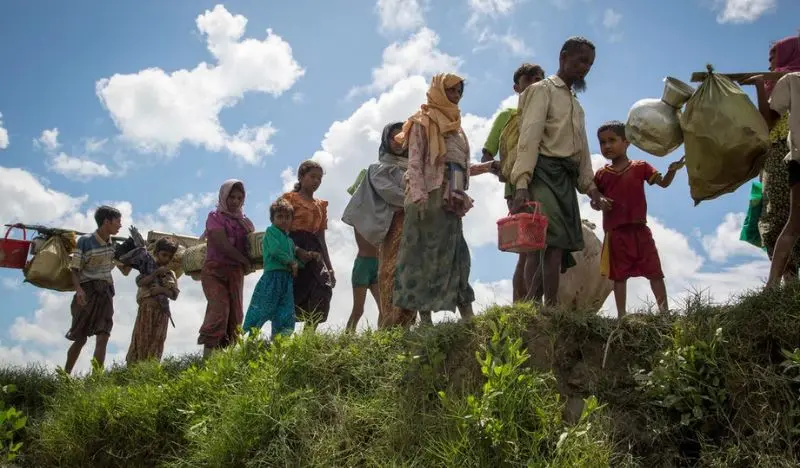
Violence escalated dramatically in August 2017 when Myanmar’s military launched sweeping “clearance operations” following attacks by Rohingya militants. UN investigators documented mass killings, gang rapes, and the razing of hundreds of villages, estimating that at least 10,000 people died. More than 700,000 Rohingya fled across the border into neighbouring Bangladesh, joining earlier waves of refugees in sprawling, overcrowded camps around Cox’s Bazar.
In November 2019, The Gambia—backed by the Organisation of Islamic Cooperation—filed the landmark case at the ICJ, invoking Article IX of the Genocide Convention. Eleven other nations, including the Maldives, Canada, the United Kingdom, France, and Germany, subsequently joined the proceedings to support the legal framework of the Convention.
Recent Developments in Myanmar
The court’s judgment arrives amid a complex and deteriorating conflict inside Myanmar. Following a February 2021 military coup that ousted the civilian government, the country descended into a multi-front civil war.
In Rakhine State, the Arakan Army—an ethnic armed resistance group fighting Myanmar’s ruling military junta—has seized control of most of the region. Human rights monitors report that the roughly 600,000 Rohingya remaining in Rakhine remain trapped between warring factions, facing renewed displacement, forced conscription by the junta, and tightened repression, arbitrary detention, and forced labour under Arakan Army control.
While ICJ rulings are final, legally binding, and without appeal, the court lacks an enforcement mechanism. Myanmar’s military authorities have historically rejected international accountability efforts, dismissing UN findings as biased. The ICJ has ordered Myanmar to submit a report within two years detailing the measures it has taken to comply with the judgment, while the specific scale and structure of reparations will be determined in subsequent court proceedings.