
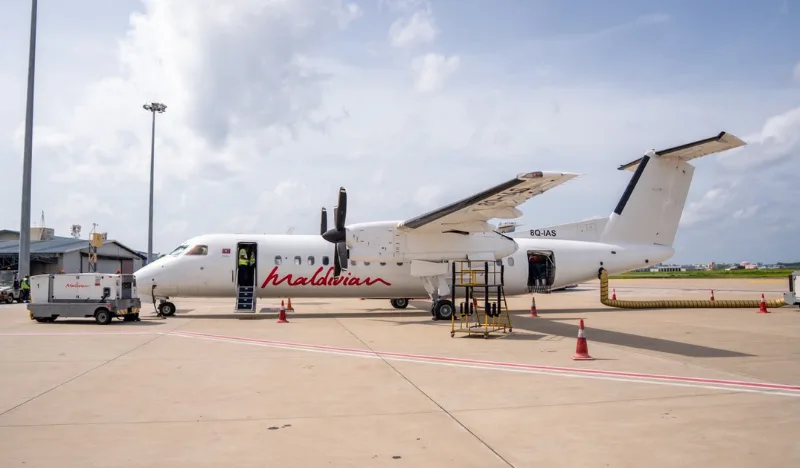
National airline Maldivian has officially retired one of its long-serving Dash 8 aircraft as part of its ongoing fleet modernisation programme.
The retired aircraft is a DHC-8-300 registered as 8Q-IAS (MSN 546). Following an open Request for Proposals (RFP) process, the aircraft departed for Canada on Thursday, marking what the airline described as an important milestone in its transition towards a more modern and sustainable fleet.


The aircraft served domestic routes across the Maldives for more than 14 years, completing over 29,000 flight hours and more than 37,000 flight cycles during its service. Maldivian said the aircraft’s journey to Canada marks its return to its original manufacturer, De Havilland Canada, 26 years after it was built.
Maldivian launched its fleet renewal programme in 2022 to gradually replace its ageing Dash 8 aircraft with newer ATR aircraft.
Managing Director Ibrahim Iyas said the cost of maintaining the Dash 8 fleet has risen significantly since production of the aircraft ended around 2009 or 2010. He noted that the remaining Dash 8 aircraft in operation are now more than 25 years old.
He said the transition to an ATR fleet is intended to support the airline’s long-term sustainability while enabling it to meet growing demand for domestic air travel.
According to Maldivian, the ATR aircraft provide greater passenger comfort, improved fuel efficiency and better environmental performance than the Dash 8 fleet. The airline said the replacement programme is also expected to improve operational reliability and reduce operating costs, with the long-term goal of operating an all-ATR fleet for domestic services.
Maldivian currently operates five ATR aircraft and has two more on order. The first is expected to be delivered later this year, while the second is scheduled to arrive by the end of next year.