
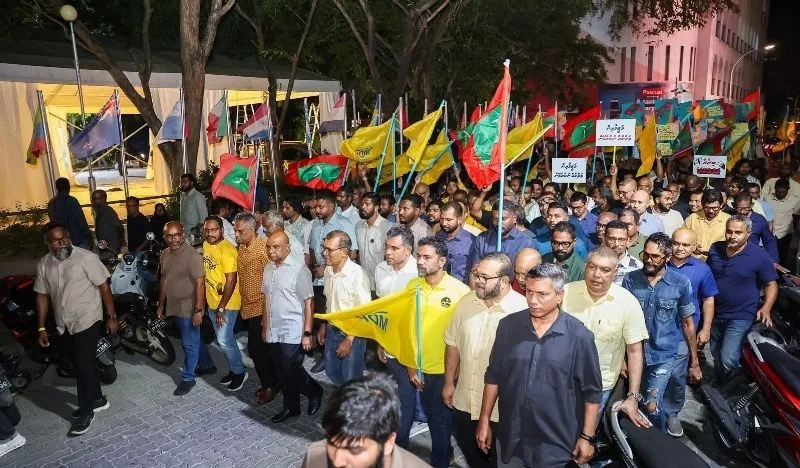
The opposition Maldivian Democratic Party (MDP) will hold a street protest on 26 November, next Thursday, demanding a public referendum before the government proceeds with its planned development project in Fushidhiggaru Falhu, also known as Rasmalé.
Speaking at a press conference, MDP Chairperson Mohamed Nasheed said proceeding with the project without public consultation and a yes-or-no vote could cause serious harm to the country.


Nasheed said the MDP’s fifth congress had adopted a policy requiring public referendums on major national projects, arguing that the government must seek public approval before moving forward with the development.
“Because the government has decided to proceed with the residency project in Fushidhiggaru lagoon, before moving forward with it, a public yes/no referendum must be held,” Nasheed said.
He added that the MDP would lead the November 26 demonstration itself rather than leave the initiative to another political party.
The protest announcement comes despite Nasheed having repeatedly expressed support for the Rasmalé project, putting him at odds with the MDP’s position on the issue.
Nasheed has publicly defended the development on several occasions, including declaring his “full and unambiguous” support for the Eagle Hills project during an MDP National Council meeting on 1 November. He has also argued that foreign investment can strengthen national development and sovereignty.
Addressing concerns about the project’s impact on the outer islands, Nasheed argued that another large-scale development in the Malé region would further contribute to the depopulation of other islands.
He said long-stay tourism and residency projects did not necessarily require multi-billion-dollar foreign companies, arguing that such initiatives could instead be developed by local councils and Maldivian businesses in less populated islands with larger land areas. He cited a similar proposal by the Addu Hulhudhoo Council.
Asked whether an MDP-led administration would cancel the agreement if it were signed without a referendum, Nasheed ruled out automatically annulling state agreements. He said a future administration could review agreements entered into by the state but warned that unilaterally cancelling sovereign contracts could damage bilateral relations and expose the government to substantial compensation claims.
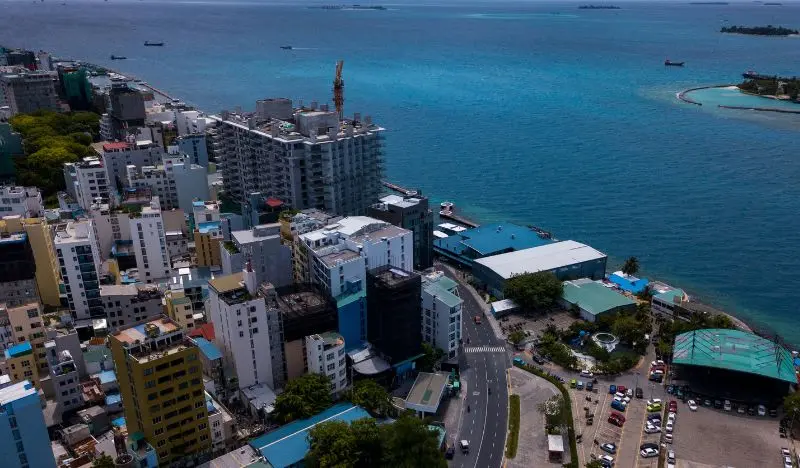
The Rasmalé project involves a proposed USD 20 billion waterfront and marina development in Fushidhiggaru Falhu, near Malé, in partnership with UAE-based developer Eagle Hills. The government signed a Commercial Terms Agreement with the company on 21 September, covering 500 hectares of reclaimed land under a proposed 99-year lease. The planned development includes residential properties, hotels, resorts, a marina and commercial facilities.
Nasheed also criticised the government’s economic management, claiming that foreign currency shortages and a rising US dollar exchange rate had increased the cost of basic commodities, particularly in the outer islands.
Nasheed claimed that the US dollar was trading above market rate, contributing to sharp price differences between Malé and the atolls.
He cited prices in Addu Hulhudhoo, where a kilogramme of basmati rice costs MVR 220, compared to MVR 110 in Malé. He also said a bottle of cooking oil sells for MVR 90 in Hulhudhoo, against MVR 35 in the capital.
“We can no longer see that this government has even the slightest idea of how to manage the Maldivian economy,” Nasheed said.
Assessing the government’s economic performance, Nasheed described the past three years as the most stagnant period for business activity in the Maldives. He claimed that shop sales across the atolls had fallen sharply and that GDP growth had dropped below one per cent, well below the approximately 10 per cent growth he said was necessary for a developing economy.
Nasheed attributed the foreign currency shortage to the government’s failure to restructure national debt, alleging that authorities had instead depleted foreign currency reserves to meet existing debt obligations.
He also blamed internal political disputes and cabinet dismissals for undermining the government’s ability to implement economic policies, claiming that the removal and sidelining of officials had left the administration without the necessary personnel to manage the economy.