
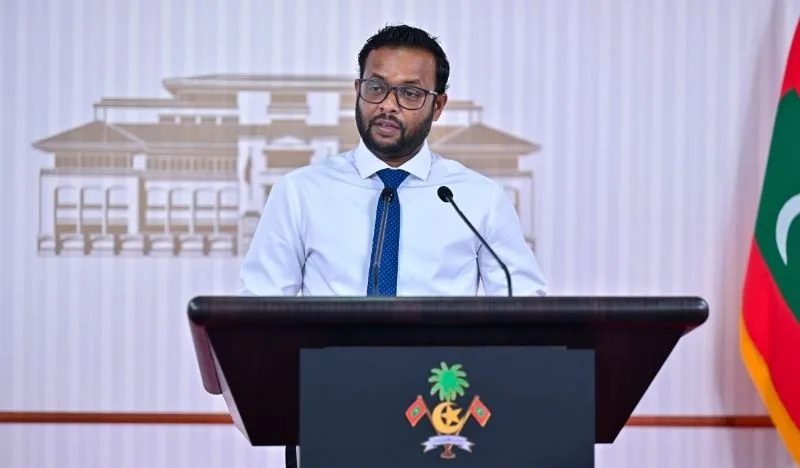
Minister of Infrastructure, Housing and Urban Development, Dr Abdulla Muththalib, has informed the Malé City Council that he will communicate with the council only through written correspondence, citing concerns over how previous discussions have been represented publicly.
The decision was revealed during a Malé City Council meeting today, where Mayor Adam Azim read a letter sent by the minister. According to the letter, Muththalib alleged that Azim had made public statements that misrepresented the content of verbal discussions between them. The minister also claimed that the council had not provided sufficient cooperation on matters discussed regarding the development of Malé and government-led projects.


As a result, Muththalib stated that written communication would be the most appropriate method of engagement going forward and requested that the council submit any matters requiring attention in writing.
The development comes days after Azim and several councillors visited Dharubaaruge, where the Ministry of Infrastructure, Housing and Urban Development operates, seeking a meeting with the minister. The mayor said the council had been unable to secure a meeting with Muththalib for more than two years despite attempts to discuss various issues affecting the capital. Ministry officials reportedly informed the council at the time that a meeting could be arranged within the week.
Responding to the minister’s letter, Azim rejected the allegations and said he had never participated in a meeting with Muththalib. He also stated that he had not spoken with the minister either in person or over the telephone.
The mayor further claimed that the council had already submitted issues to the ministry in writing but had not received responses to its correspondence.
The dispute is linked to the long-delayed redevelopment of the Malé fish market, a project that has become a point of contention between the city council and the government.
In February, Azim announced that the council was seeking to cancel the fish market redevelopment agreement after an audit reportedly identified significant financial and legal risks. According to the mayor, the original USD 6.1 million contract was replaced shortly before he took office with a revised agreement valued at USD 9.6 million.
Azim said the revised contract requires the council to pay USD 9.5 million, warning that failure to do so could allow the contractor to gain control of the fish market site for 25 years. The council subsequently referred the matter to the Anti-Corruption Commission and the Auditor General’s Office.
The redevelopment project was initiated during the mayoralty of President Dr Mohamed Muizzu. Both President Muizzu and Minister Muththalib have previously attributed delays in the project to a lack of cooperation from the city council.
Azim, however, has maintained that the dispute centres on legal issues surrounding land ownership and jurisdiction. He has argued that any agreement involving Malé City Council land must comply with legal requirements and be made with the consent of the council, adding that unresolved legal questions must be addressed before the project can proceed.
“The land of the Malé City Council is the land of the citizens of Malé City; they should sign a contract regarding that land after examining the condition of that land and having both parties come to an agreement on that land. That is what the law says, and the ministry must also act according to what the law says,” Mayor Azim said.