
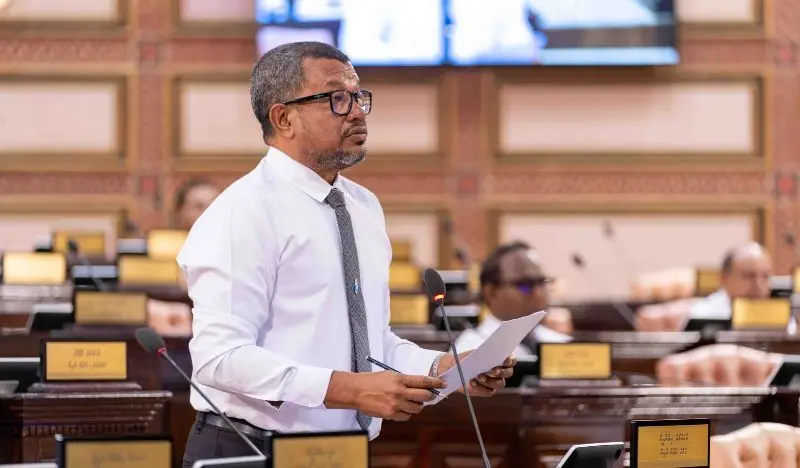
Opposition MP for Galolhu North Constituency Mohamed Ibrahim (Kudoo) has revealed that 20 of the 240 individuals listed on the Gender Ministry’s child sex offenders registry, who are supposed to be serving prison sentences, are currently living at home.
Mohamed Ibrahim cited the systematic failures in law enforcement, judiciary and state accountability in People’s Majlis during a heated debate on the government-sponsored Death Penalty Enforcement Bill.


The Maldivian Democratic Party (MDP) lawmakers warned that resuming executions under a compromised justice system risks wrongful convictions, while ruling People’s National Congress (PNC) members defended the bill as a necessary religious and security measure.
The MP questioned whether the state can fairly administer the death penalty when convicted offenders remain free and corruption permeates public institutions. He pointed out that individuals with unresolved disciplinary cases are still being appointed as judges and magistrates, alongside a recent report uncovering over MVR 300 million in undocumented corruption within state-owned enterprises.
“From building mosques to Hajj quotas, we are constantly being deceived. When things are like this, there is concern over whether the death penalty will be implemented properly,” Mohamed Ibrahim said. “It is a bitter truth we must all accept that there will be corruption spanning from building mosques all the way to purchasing the rope used for hangings. A person’s life must not be taken unless a thoroughly fair trial has been conducted.”
Warning that major flaws in the criminal justice system could lead to people being framed and executed, the MP described wrongful capital punishment as one of the opposition’s gravest concerns.
Kendhoo MP Mauroof Zakir, also of the MDP, raised technical and procedural objections to the draft legislation, pointing to conflicts of interest regarding the separation of powers on the proposed oversight panel.
According to the MP, under the current draft, a sitting MP on the panel is disqualified if they speak either for or against a case. MP also flagged potential conflicts under Article 24(a) regarding judicial reviews involving private parties, and criticized Article 46(d) for exempting panel members from disclosing how they voted on life-or-death decisions.
Additionally, MP highlighted Article 42, which requires restarting the entire execution procedure from the beginning if a hanging fails. Questioning the fairness of subjecting an individual to the process twice, he asked how a failed execution could even be proven when the bill strictly prohibits photography and video recording, urging the parliamentary committee to resolve these flaws.
In contrast, ruling PNC MP for Baarah Constituency Ibrahim Shujau argued that previous administrations had allowed street violence and fatal stabbings to erode national peace by failing to enforce Islamic mandates.
“Such things happen because we do not shape our actions according to what Allah has commanded. Such things happen when the leaders governing the country act out of cowardice,” Shujau said, asserting that the Maldives must not shrink from implementing the death penalty out of fear of losing foreign aid or severing diplomatic ties.
Sponsored on behalf of the administration by Guraidhoo MP Hanan Mohamed Rasheed, the Death Penalty Enforcement Bill seeks to establish formal rules governing how capital cases are adjudicated and enforced.
Under its provisions, executions will be carried out by hanging in private under the operational direction of the Maldives Correctional Service, overseen by a seven-member panel required to set an execution date within 30 days of its formation. The bill also mandates temporary stays of execution on certified medical or mental health grounds, as well as for pregnant women and nursing mothers until their child reaches two years of age.
The legislative push follows the Third Amendment to the Drugs Act, which took effect on March 6, 2026, introducing capital punishment for trafficking large quantities of illicit drugs, specifically over 350 grams of cannabis, 250 grams of heroin, or 100 grams of other Schedule One substances.
According to Right to Information records obtained by MV+ from the Prosecutor General’s Office, prosecutors are currently pursuing the death penalty against 17 individuals across 11 trafficking cases, alongside 94 others facing mandatory life imprisonment without parole. All 111 defendants are legally barred from plea bargains, charge reductions, or presidential pardons, though all 11 capital cases remain in preliminary trial stages and have yet to reach the mandatory unanimous review before the Supreme Court.
The administration’s move to operationalize capital punishment has drawn strong opposition from a coalition of ten local and international rights groups, including Human Rights Watch, which has urged authorities to preserve the Maldives’ de facto moratorium. No judicial execution has been carried out in the country since 1954, when Hakim Didi was hanged on Dhoonidhoo island for attempting to assassinate the nation’s first president, Mohamed Amin Didi.