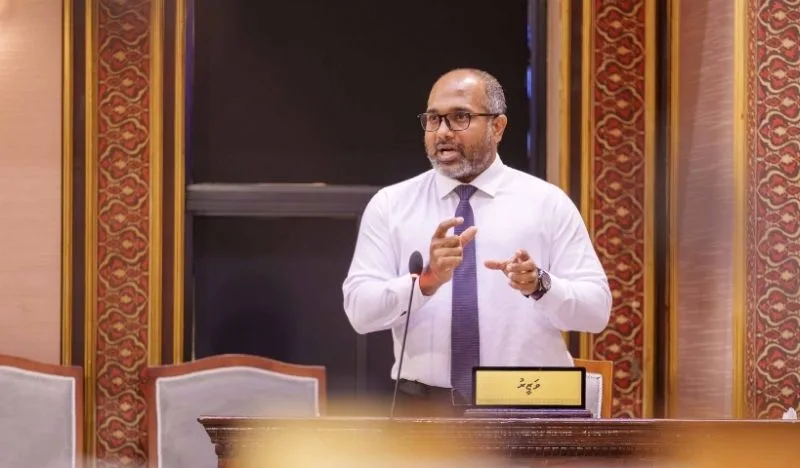

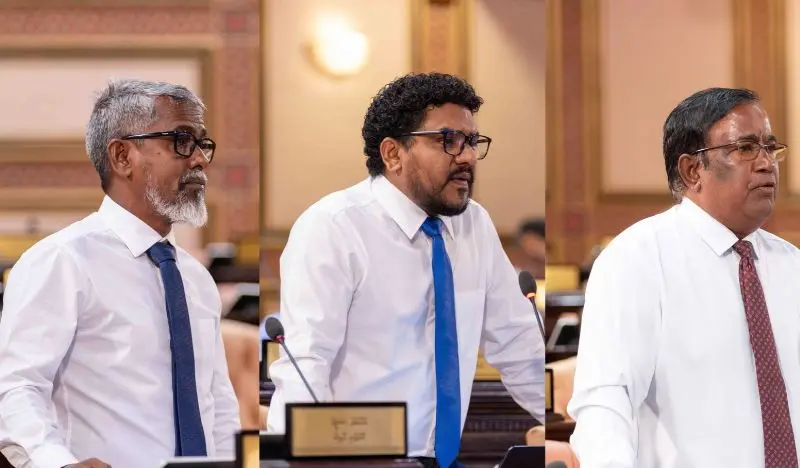
Opposition lawmakers mounted fierce criticism in the People’s Majlis against the government-backed Defamation Bill, accusing the administration of attempting to intimidate citizens, muzzle the press, and shield itself from scrutiny over state corruption and the Rasmale’ development project.
During parliamentary debate proposed by MP for Villimale constituency Mohamed Ismail on the Bill on the Right to Protect Name and Reputation, opposition MPs argued that the legislation is designed to stifle public dissent through vague definitions and punitive financial penalties.


Kendhoo Constituency MP Mauroof Zakir alleged that the sudden introduction of the bill was directly motivated by a desire to halt public discussion surrounding the Rasmale’ project and broader allegations of state mismanagement. Accusing the government of driving the economy into distress and “selling off the lagoons and reefs” of the Maldives, Mauroof argued that classifying criticism of such actions as defamation was unacceptable.
“Today, when citizens come out and tell a liar that they are lying, it is being made a crime,” Mauroof told the chamber, adding that provisions exposing even Members of Parliament to penalties revealed the government’s true intent. Citing authorities’ inability to track down and jail the anonymous social media account “Hassan Kurusee” as evidence that punitive laws fail to deter critics, he warned that efforts to silence the public would yield no results.
Echoing these concerns, Vaikaradhoo Constituency MP Hussain Ziyad stated that while protecting personal reputation is legitimate in principle, the bill’s primary objective is to conceal government corruption and systemic irregularities. Drawing parallels to a controversial defamation law enacted in 2016, Ziyad noted that although the current legislation is framed as a civil statute, it relies on overly broad language including clauses targeting physical gestures, and heavy financial penalties to deter whistleblowers and critics.
Hanimaadhoo Constituency MP Abdul Ghafoor Moosa similarly warned that attempts to intimidate the public and “tape journalists’ mouths shut” would ultimately fail and face public rejection. Ghafoor argued that safeguarding one’s reputation is a personal, religious, and legal responsibility, noting that public scrutiny is a natural consequence of wrongdoing. “When a person harms their own reputation through their own actions, the public will talk about it,” he said.
The proposed law could allow individuals to sue over non-verbal expressions, including gestures and facial expressions, if they are considered defamatory, potentially extending legal liability beyond spoken and written statements.
Under the bill, individuals and organisations could bring civil defamation cases against anyone whose statements or representations meet the legal definition. The legislation applies to Maldivian citizens, foreign nationals, companies, associations, media organisations, publishers and administrators of digital platforms.
The proposed law sets out the following remedies:
- Compensation: Courts could award moral damages ranging from MVR 50,000 to MVR 500,000, depending on the severity and reach of the alleged defamation.
- Material damages: Compensation could also cover proven financial losses, lost income and commercial harm.
- Public apology: Courts could order an unconditional public apology.
- Retraction and removal: Courts could order the publication of corrections or retractions, or the removal of articles, recordings and other content found to be defamatory.
- The bill also allows the court to reduce damages where the accused party has promptly apologised, retracted the statement or otherwise made amends.