

Over 1,100 Individuals Undergo Court-Ordered Drug Rehabilitation
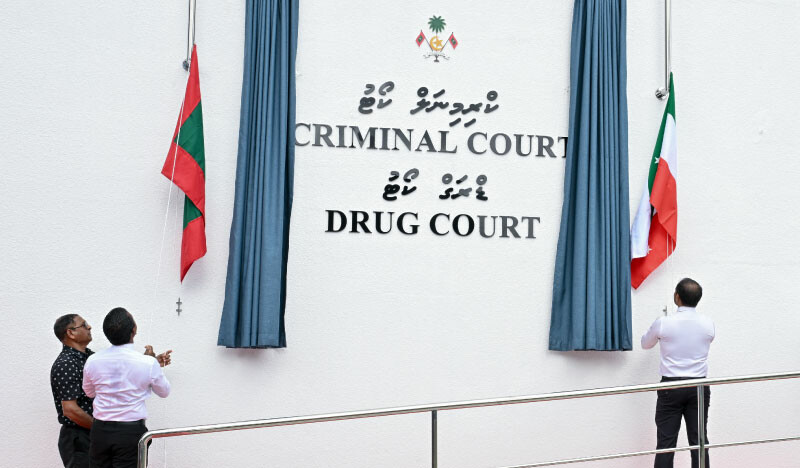
The newly relocated Criminal Court and Drug Court at the Justice Building Annex in Hulhumalé on July 27, 2025 | Photo: President’s Office
More than 1,100 individuals are currently undergoing court-mandated treatment across various phases of rehabilitation, according to official monthly figures released by the Drug Court for September 2026.
The data reveals that 1,118 people are currently bound by court orders. A majority 629 individuals, have been in treatment for under a year, while 375 people have been undergoing rehabilitation for between one and three years.
A further 88 individuals have been in the treatment phase for three to five years, and 26 people have remained under court-ordered treatment for over five years.
The figures align with annual enforcement trends published by the Prosecutor General’s Office. According to its 2025 Annual Report, cases involving 932 individuals were submitted to the Drug Court, with charges overwhelmingly dominated by heroin and cannabis offences.
The report showed that 930 of those defendants were adults over 18, while two cases involved minors. Demographic data underscores a severe gender disparity among those referred to the court, with men accounting for 885 cases (95 per cent) and women comprising 47 cases (5 per cent).
Prosecuting authorities filed 516 charges for diamorphine (heroin) use and 426 charges for cannabis use during the year, alongside ten charges submitted for alcohol consumption.
Police statistics indicate that 2,043 drug-related cases have been reported so far this year, compared to 2,066 recorded during the entirety of last year.
The issue of substance abuse, particularly involving injectable narcotics, intersects with broader public health monitoring in the country. Speaking at a press conference at the President’s Office, Minister of Health Geela Ali noted that the updated national registry records a cumulative total of 71 HIV cases, with 53 individuals currently living with the virus in the Maldives.
Minister Geela emphasised that the Maldives maintains its global classification as a low-prevalence nation, with HIV affecting approximately 0.01 per cent of the total population since the first case was detected in 1991.
Health authorities continue to monitor key risk factors associated with blood-borne transmission, including the sharing of syringes or needles during intravenous drug use, alongside unprotected sexual intercourse, mother-to-child transmission during pregnancy or childbirth, and infected blood transfusions.