
The People’s Majlis has passed the government’s proposed MVR 59.7 billion state budget for the upcoming year exactly as submitted, without introducing any changes on the parliamentary floor.
While the Budget Review Committee also made no revisions to the budget, the opposition Maldivian Democratic Party (MDP) submitted several amendments to the committee’s report during today’s sitting. Out of the 21 amendments proposed by the party, only seven were granted the opportunity to be presented on the floor.


The budget was passed with the votes of 65 members. Thirteen MDP lawmakers did not vote in favor of the budget, and none of the amendments proposed by the party were passed.
The MVR 59.7 billion budget proposed for next year is MVR 4.5 billion lower than this year’s budget of MVR 64.2 billion. However, spending on government operations and development projects has increased by MVR 3.3 billion, reaching MVR 52.6 billion. With total revenue projected at MVR 43.2 billion, the budget deficit has widened to MVR 9.4 billion.
Although the committee decided to approve the budget as proposed by the government, both the central bank (Maldives Monetary Authority) and the Auditor General had warned of significant fiscal risks within the budget. In particular, they highlighted that recurrent expenditure consumes 101 percent of revenue excluding grants, and pointed out the lack of a clear plan to recover unpaid funds owed to the state. Despite these concerns, no amendments were introduced during the committee stage to reduce budget expenditures.
Opposition Warns of Surging Debt and Rising Food Prices
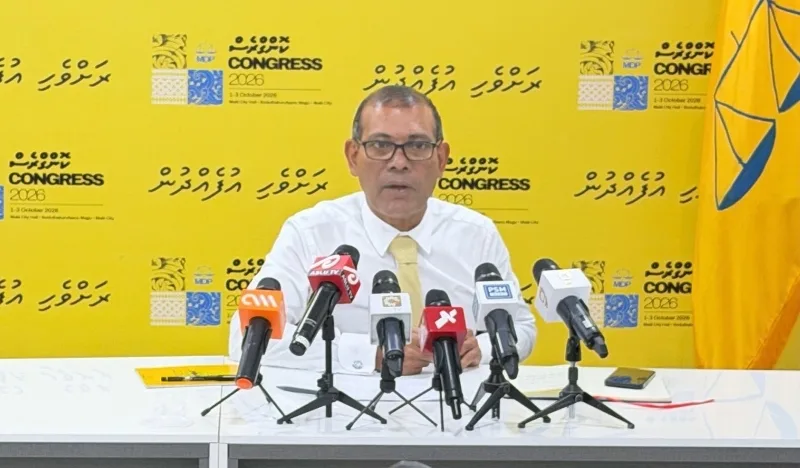
Ahead of the vote, the opposition MDP Parliamentary Group held a press conference yesterday warning that the proposed budget will sharply drive up national debt and the cost of basic goods.
MP Abdul Ghafoor Moosa disputed the government’s claims that public infrastructure projects have been stalled due to loan repayments. He stated that national debt is projected to surge from MVR 123 billion to MVR 168 billion by the end of the budget term, accusing the administration of accumulating MVR 38 billion in new debt, more than any previous government while allocating no more than MVR 10 billion toward actual loan repayments.
MP Ziyad noted that despite extensive recommendations submitted by independent institutions during the review stage, the budget was returned to the Parliament floor completely unchanged. Warning of direct impacts on household expenses, MP Meekail stated that passing the budget in its current form would drive up the prices of everyday staples such as onions, carrots, and potatoes over the coming year, declaring that he would not vote in favor of the bill.
Fiscal Leaks, Resort Audits, and Exchange Rate Warnings Raised in Committee
Deliberations within Parliament’s Budget Review Committee also spotlighted major revenue leaks and foreign exchange vulnerabilities. Deputy Speaker and Eydhafushi MP Ahmed Saleem warned that the state is bleeding roughly MVR 2.5 billion annually in lost customs revenue due to widespread fraudulent invoicing and the deliberate under-valuation of imported goods by importers concealing true purchase values.
Meanwhile, Maldives Monetary Authority (MMA) Governor Ahmed Munawwar pointed to a stark foreign currency leak in the tourism sector, revealing that while the industry generates roughly USD 5.9 billion a year, only USD 3.8 billion enters the domestic banking system.
Stressing that the central bank is stepping up surveillance to ensure foreign receipts are brought onshore, Munawwar urged the Maldives Inland Revenue Authority (MIRA) to thoroughly audit luxury resort properties rather than limiting its scrutiny to small corner shops.
Citing data supplied by the tax authority itself, Munawwar questioned why only about 50 of the nation’s 185 operating resorts pay corporate income tax. “What does that imply? Either they are genuinely making no profit, or there are underlying irregularities,” Munawwar told lawmakers. “Doesn’t that warrant an audit? Their books must be audited. MIRA shouldn’t just be knocking on the doors of corner shops. We have to verify whether the accounts in our tourism industry are properly in order.”
In response, MIRA maintained that while its core strategy centers on stakeholder support and voluntary compliance, firm statutory penalties continue to be enforced against any operator found deliberately dodging tax obligations.
Responding to queries from South Hulhumalé MP Dr Ahmed Shamheed during the committee meeting, Governor Munawwar also cautioned that the Maldives cannot transition to a market-driven, flexible exchange rate until usable foreign exchange reserves reach at least USD 1 billion.
Explaining that the central bank currently lacks effective control over the domestic foreign exchange market because substantial currency flows remain outside its regulatory orbit, Munawwar warned that floating the Maldivian Rufiyaa under prevailing market conditions would trigger severe economic fallout. “The reason we cannot float the currency right now is that the central bank does not dictate the foreign exchange market,” he told MPs. “A substantial share of the foreign exchange market remains in hands other than the MMA. Therefore, unless our usable reserves reach USD 1 billion, I would strongly advise against taking such a step.”
MDP Amendments Rejected by PNC
During today’s floor debate, several MDP amendments aimed at reallocating funds were voted down by the ruling People’s National Congress (PNC) majority. MP Mohamed Ameen Faisal proposed allocating MVR 250 million from the contingency budget to the health and education sectors to cover overtime pay and recruit necessary technical staff, while calling for the abolition of the 10 percent overtime pay ceiling, which he argued violates the Employment Act—and requesting a human resources audit.
Hithadhoo North MP Abdulla Sodiq called for disclosing the island-by-island breakdown and timelines of the MVR 8.2 billion allocated for Public Sector Investment Programme (PSIP) projects prior to the budget’s approval. He also proposed allocating MVR 100 million from the contingency budget toward the salaries of local councils and Women’s Development Committees (WDCs) under pay harmonization, alongside securing funds to complete the Addu Airport project.
Thoddoo MP Hussain Sameer proposed officially incorporating state-owned enterprise (SOE) financial assistance into the budget, specifically calling for a MVR 399 million subsidy for Island Aviation in accordance with the audit report and the formal inclusion of a MVR 60 million government loan previously issued to the Road Development Corporation (RDC). Additionally, Hulhumalé South MP Ahmed Shamheed proposed earmarking MVR 200 million from the contingency budget to complete stalled water and sewerage projects.