
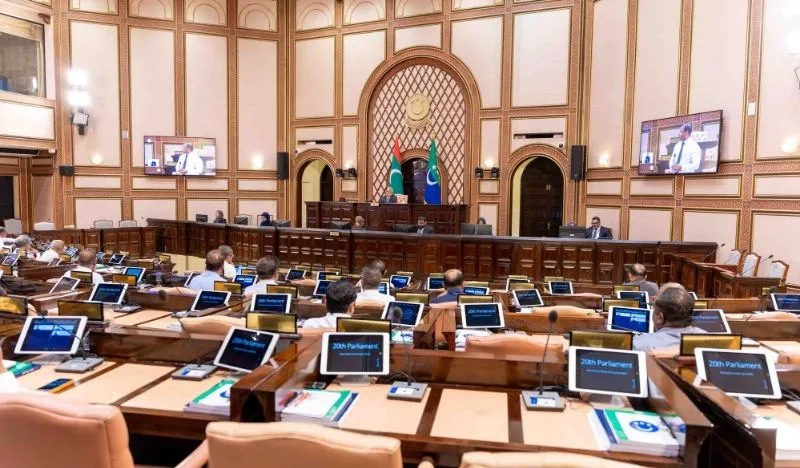
The People’s Majlis will begin parliamentary debate tomorrow morning at 9:00 a.m. on the government-sponsored Real Estate Business Bill, widely referred to as the “Ras Malé Bill”.
Sponsored on behalf of the administration by Henveiru North MP Ahmed Aifan, the legislation headlines a busy parliamentary agenda. Alongside the real estate bill, lawmakers are scheduled to debate the Bill on Death Penalty Enforcement bill proposed by Guraidhoo MP Hanaan Mohamed Rasheed, as well as the Right to Protection of Reputation and Name Bill, introduced by Villimalé MP Mohamed Ismail.


Furthermore, MPs will debate on the Maldives Immigration Bill, submitted by Kulhudhuffushi North MP Mohamed Dawood, while proceeding with ongoing discussions on the proposed 2027 State Budget.
The parliamentary debate follows President Muizzu’s firm rejection last week of opposition calls to put the multi-billion-dollar Ras Malé initiative to a public vote under the Referendum Act. Speaking at a press conference on November 9, the same day the bill was formally submitted to the Majlis the President dismissed mounting criticism as “baseless claims” made for political gain.
“This is not something on which we will hold a referendum,” President Muizzu stated when questioned on the project’s long-term impact on future generations. Defending the statutory framework behind the development, he added that the bill accounts for existing Maldivian laws, citizen rights, and the preservation of national sovereignty and integrity.
Opposition resistance escalated last Friday during a rally organized by the “Dhivehinge Bin Dhivehinah” (Maldivian Land for Maldivians) national movement, where former President Abdulla Yameen Abdul Gayoom pledged that any incoming administration would immediately void the Ras Malé land deal without compensation.
“By the grace of Allah, I firmly believe that whether it is my government or an MDP government, if anyone other than this current administration wins the next election, there is no doubt about it,” Yameen told the crowd. Directing his remarks at UAE-based Eagle Hills founder Mohamed Alabbar, the former president warned: “Listen Alabbar. Listen Zionists. Even if this land is handed over to you, it will be taken back, and no compensation will be paid. This land is not being given in accordance with the laws of the Maldives”.
Yameen further asserted that all individuals involved in facilitating the agreement would face criminal investigations, prosecution, and legal penalties once a new government takes office.
The political backlash centers on the commercial terms agreement signed on September 21, 2026, between the Ministry of Infrastructure, Housing and Urban Development and Eagle Hills, which allocates 500 hectares of reclaimed land in Ras Malé under a 99-year leasehold.
Alongside street protests, the deal faces active legal opposition. Legal counsel and former MP Ali Hussain has petitioned the Supreme Court for a review following the Court Registrar’s procedural dismissal of a constitutional challenge against the agreement. Backed by the “Maldivians’ Land for Maldivians” campaign, the petition contends that granting state land without rent or acquisition fees breaches Article 250 of the Constitution, while long-term foreign leasehold structures contravene Article 251.
Designed to provide the statutory backing for major property developments, the Real Estate Business Bill seeks to establish the country’s first dedicated framework to regulate property developers, govern transactions, and protect buyers across residential and commercial projects. Key objectives include instituting mandatory developer registration, securing buyer financial interests, and enforcing state compliance monitoring.
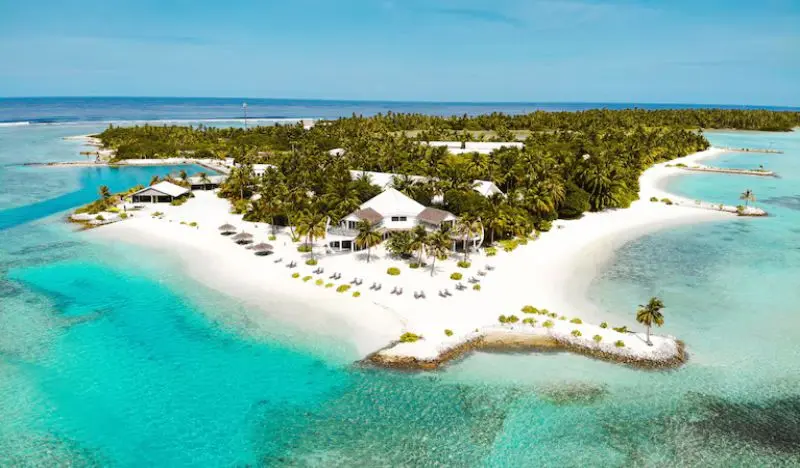
The legislation also draws a strict regulatory boundary within designated Integrated Real Estate Zones such as Ras Malé. Under Article 77(d), the importation, sale, possession, and consumption of alcohol and pork remain strictly prohibited across primary residential and commercial areas, maintaining standard domestic restrictions alongside nationwide bans on casinos and gambling. Conversely, under Articles 76(b) and 77(c), developers may separately dredge lagoons to build detached tourism facilities governed entirely under the Maldives Tourism Act, allowing standard resort-style permits for alcohol and pork on those isolated satellite islands.