

President and First Lady Visit Thalassaemia Centre in Hulhumalé
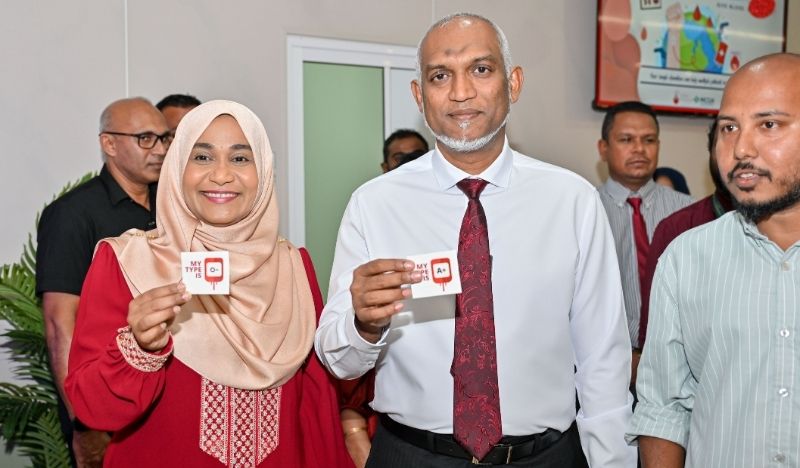
President Dr Mohamed Muizzu (R) and First Lady Sajidha Mohamed holding out papers with their blood types | Photo: President’s Office
President Dr Mohamed Muizzu and First Lady Sajidha Mohamed visited the Thalassaemia and Other Haemoglobinopathies Centre at Orange Hiyaa in Hulhumalé this afternoon, on World Blood Donor Day, where they reviewed services provided to patients and related healthcare facilities.
The centre operates in collaboration with Maldivian Blood Services (MBS). During the visit, the President and First Lady toured patient wards, the blood donor facility, laboratory, and the Thalassaemia Patient Care Centre. Officials also briefed them on the scope of services delivered at the facility.
advertisement

Upon arrival, they were received by Minister of Health, Family and Welfare Geela Ali and Chief Executive Officer of the Malé City Group of Hospitals Ibrahim Abdul Razzaq Haleem. Chief Government Spokesperson Mohamed Hussain Shareef also accompanied the visit.
President Dr @MMuizzu and First Lady @sajidhaamohamed visit the Thalassaemia Centre at Orange Hiyaa to commemorate World Blood Donor Day. pic.twitter.com/ZDJmrhxiKY— The President's Office (@presidencymv) June 14, 2026
The administration has prioritised strengthening healthcare services, financial assistance, and infrastructure for individuals living with thalassaemia. The President has consistently underscored the government’s responsibility to ensure comprehensive healthcare and social protection for affected individuals and their families.
Separately, marking World Blood Donor Day, President Muizzu reaffirmed the administration’s commitment to promoting voluntary blood donation, highlighting its importance in supporting patients with lifelong conditions and those requiring emergency care.
In a message shared on his official X account, the President noted that voluntary blood donors play a critical role in saving lives and ensuring timely medical support for patients in need.
He added that blood remains an irreplaceable resource despite advances in medical science, and emphasised that voluntary donation is essential for safeguarding public health, strengthening healthcare delivery, and improving national emergency preparedness.
He further noted that for a geographically dispersed island nation like the Maldives, timely access to blood can make a decisive difference in medical emergencies. The administration, he said, remains committed to raising awareness, promoting voluntary blood donation, and strengthening a culture of solidarity and shared responsibility in protecting public health.