
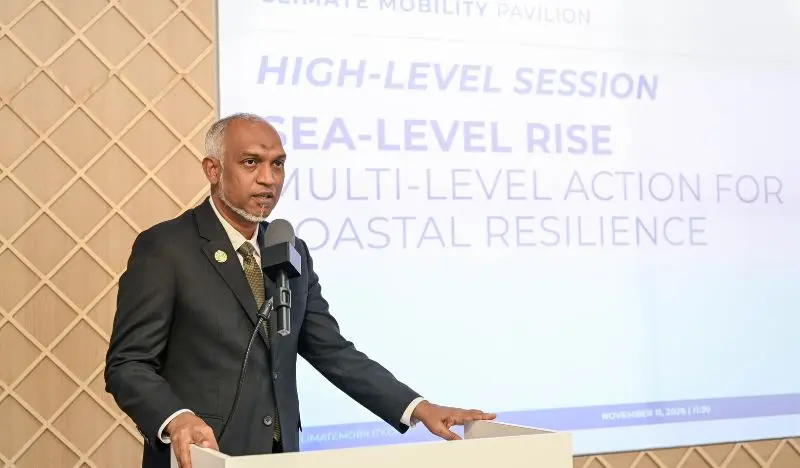
President Dr Mohamed Muizzu has returned to the Maldives after concluding his official visit to Turkey, where he attended the 31st Session of the Conference of the Parties to the United Nations Framework Convention on Climate Change (COP31).
Accompanied by First Lady Sajidha Mohamed and a high-level government delegation, the President took part in the summit held under the theme “Towards a Sustainable, Resilient and Equitable Future”, which commenced on 10 November.


Delivering the Maldives’ National Statement at the conference in Antalya, President Muizzu called on the international community to provide the financial backing necessary for the Maldives to adapt to escalating climate risks, warning that vulnerable island nations should not be forced into crippling debt to survive a crisis they did little to cause.
He emphasised that as global temperatures push past the 1.5°C threshold, the Maldives remains resolute in building a resilient future, but requires urgent international cooperation across three core pillars: finance, systemic reform, and implementation.
Addressing the first priority, climate finance, the President urged developed nations to honour their longstanding commitments by ensuring support is new, additional, predictable, and grant-based. He called for the immediate replenishment of the Green Climate Fund, adequate capitalisation of the Adaptation Fund, and sufficient resourcing for the Loss and Damage Fund.
“Countries like the Maldives, which have contributed minimally to creating this climate crisis, cannot be expected to fall into debt simply to adapt to it,” President Muizzu stated, stressing that climate resilience must not come at the cost of an unsustainable debt burden.
He also urged comprehensive reforms to the global financial architecture to better account for the unique vulnerabilities faced by Small Island Developing States (SIDS), while stressing the need to translate political commitments into tangible action on the ground.
Throughout the summit, the President participated in several high-level roundtable discussions on climate action, sharing the frontline challenges confronting vulnerable island nations and advocating for scaled-up international financial and technical support.
First Lady Sajidha Mohamed also addressed a high-level meeting of the Global Zero Waste Alliance during the visit. In her remarks, she highlighted the severe damage marine pollution inflicts on coral reefs, marine ecosystems, and food security, reminding delegates that discarded waste does not simply vanish once thrown away.
On the sidelines of the summit, the President and First Lady held bilateral discussions with heads of state, leaders of international organisations, and key figures working across the global climate sector.