
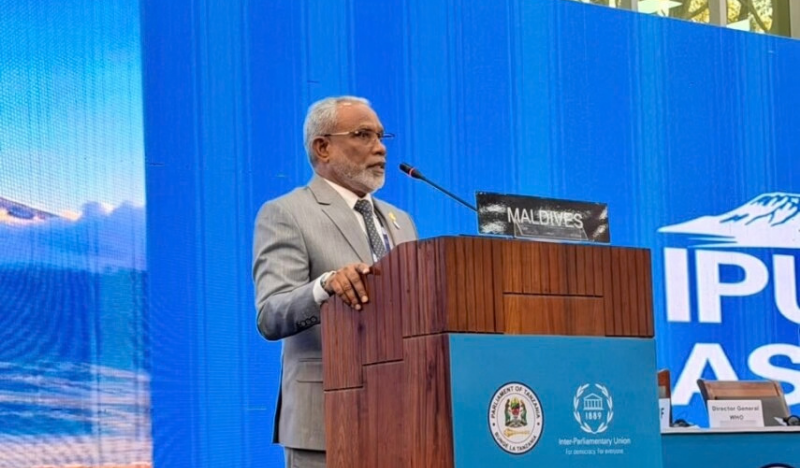
Public trust in democratic institutions is fundamentally built on transparency, accountability, integrity, and deliverable results, Speaker of the People’s Majlis, Abdul Raheem Abdulla, told global lawmakers at the 153rd Assembly of the Inter-Parliamentary Union (IPU).
Delivering his address at the assembly in Arusha, Tanzania, Speaker Abdul Raheem highlighted mechanisms such as the Right to Information Act, public petitions, digital platforms, and oversight bodies like the Anti-Corruption Commission as essential tools for enhancing public engagement and institutional integrity.
Addressing this year’s assembly theme, “Promoting good governance and empowering communities through inclusion, trust, and opportunities for all,” the Speaker underscored the need for a people-centred governance system to reinforce democratic structures.
He noted that good governance extends beyond creating institutions, requiring governments to actively listen to citizens, provide equal opportunities, and ensure state bodies remain answerable to the public.
Abdul Raheem stressed that the responsibilities of parliaments extend beyond legislative drafting. He called on legislatures to monitor policy implementation, ensure the responsible use of state resources, and broaden community involvement in decision-making processes.
Addressing the unique geographical layout of the Maldives, he pointed to digital tools such as “eFaas” as practical solutions to bridge geographical barriers and deliver government services directly to citizens across dispersed islands.
Abdul Raheem also linked good governance directly to global peace and security. Pointing to ongoing conflicts in the Middle East and Palestine, as well as violence across parts of Africa, he stated that parliamentarians hold a responsibility to uphold international law, protect human dignity, and pursue peaceful resolutions through dialogue.
He further advocated for evidence-based and results-oriented parliamentary decision-making, arguing that laws and policies must ultimately be evaluated by the tangible outcomes they deliver to the public.
Concluding his address, Abdul Raheem stated that the true measure of good governance lies in the positive transformations brought to people’s daily lives rather than the mere existence of strong institutions. He called for parliaments worldwide to become more inclusive, transparent, and responsive, reaffirming the commitment of the Maldives to collaborate with international parliaments through the IPU to strengthen democratic governance.