
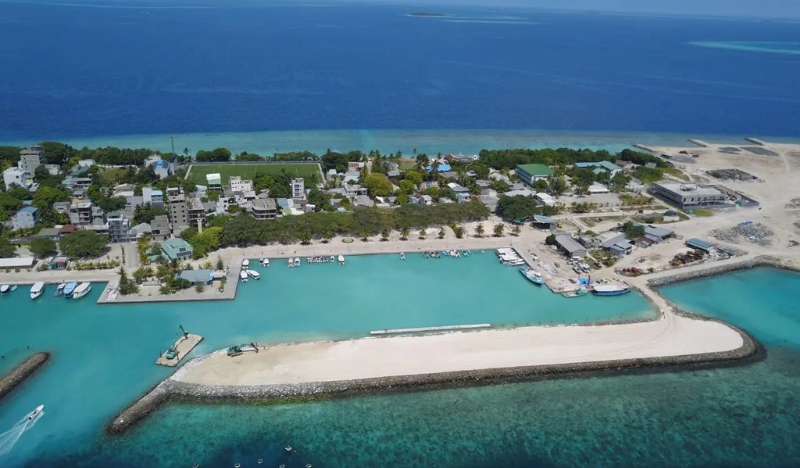
Ukulhas Council failed to recover MVR 6.16 million in outstanding land lease payments and did not take the enforcement measures required under state financial regulations, according to a compliance audit report.
The compliance audit of Alif Alif Atoll Ukulhas Council 2024 identified multiple instances of non-compliance, weaknesses in financial controls, procurement breaches and irregularities in the management of public funds.
According to auditors, the council failed to initiate the statutory recovery procedures required under the State Finance Regulations to collect MVR 6,161,303 in outstanding land lease revenue accumulated up to November 2025.
The audit also identified breaches in land allocation and leasing requirements. Land for fish processing, drying and salting was leased for four years without a public bidding process, despite regulations governing land leased for non-residential purposes limiting such leases to one year.
In another case, a four-year land lease granted in 2020 was issued below the legally prescribed minimum rental rate. The council collected MVR 42,000 from the lease, although the applicable minimum rate would have generated MVR 96,000, resulting in a MVR 54,000 shortfall.
Auditors also noted that additional land had been leased for fish salting, but the council failed to provide the relevant agreements. As a result, the auditors said they were unable to determine the financial loss arising from those leases.
The report further highlighted weaknesses in cash management. During a cash count conducted on 3 December 2025, auditors identified an MVR 8,925 discrepancy between the amount that should have been held in the council’s safe according to their calculations and the actual balance recorded in the safe register. The auditors calculated that MVR 27,665 should have been in the safe.
Auditors also found MVR 25,801 in cash in the desk drawer of the employee responsible for collecting money. As there was no documentation showing the source or purpose of the funds, auditors said they were unable to verify the nature of the cash.
The audit further found that money collected by the council was not deposited into its bank accounts regularly. Cash withdrawn from the safe for deposit took an average of 10 days to reach the bank, which auditors warned could create opportunities for the loss or misuse of public funds.
Procurement procedures were also bypassed in several instances. The council awarded an MVR 245,000 football ground repair project directly to a private association without issuing a public announcement or conducting a competitive bidding process, following a request from the organisation.
The council also split project works into smaller components, with MVR 78,862 spent across multiple instances on repairs to Masjid al-Furqan and construction of a cemetery perimeter wall, according to the audit.
The report also highlighted the council’s outstanding electricity payments to the State Electric Company (STELCO). After failing to settle several electricity bills between December 2020 and May 2025, the council entered into an instalment agreement with STELCO in July 2025.
Under the agreement, the council was required to pay MVR 4.4 million in outstanding electricity charges, while STELCO agreed to waive MVR 3.3 million in accumulated late-payment penalties.
The agreement stipulated that if the council failed to make payments for two consecutive months, the agreement would become void and the waived penalties would be reinstated.
According to the audit, the council had already defaulted on payments for two consecutive months by the time of the audit, meaning the waived penalties could be reinstated.