

President Proposes Reserved Parliamentary Seats for Youth and Women
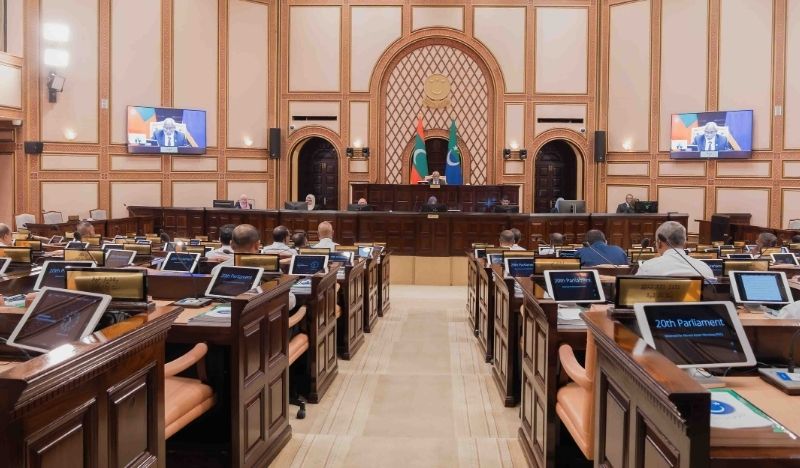
Parliament sitting on 08 March 2026 | Photo: People’s Majlis
President Mohamed Muizzu has announced plans to reserve a proportion of parliamentary seats for young people and women, as part of a broader package of constitutional and governance reforms under consideration.
Speaking at the weekly press briefing held at the President’s Office this morning, the President said the proposed changes would be pursued following upcoming local council elections, women’s committee elections, and a nationwide referendum scheduled for 4 April.
advertisement

Muizzu stated that the reforms would ultimately depend on public approval through the referendum process. Among the proposals is the introduction of a quota system in Parliament to ensure representation for individuals under the age of 30, alongside a dedicated percentage of seats for women.
“One aspect is to determine that a certain percentage of Members of Parliament are young people under the age of 30,” he said. “And a certain percentage of them are women.”
At present, reserved representation for women is only implemented at the local council level in the Maldives.
The President also highlighted that one of the key questions in the upcoming referendum will be whether to shorten the term of Parliament and align parliamentary elections with presidential elections, allowing both to be held on the same day.
In addition, Dr Muizzu signalled his intention to curb the steady increase in the number of MPs. Under the current system, parliamentary representation expands in line with population growth. The existing Parliament consists of 93 members, but the President noted that this figure could exceed 100 in future if current trends continue.
According to constitutional provisions, two MPs are elected for the first 5,000 registered voters in each constituency, with an additional member allocated for every subsequent 5,000 people. This formula has led to a gradual rise in parliamentary seats each term, which places a growing burden on government expenditure.
The President said amendments would be considered to limit this growth, alongside proposals to introduce a single-round presidential election system and to change the presidential inauguration date from 17 November to 11 November.
Dr Muizzu further indicated that work is ongoing on judicial reforms, including changes to the composition of the Judicial Service Commission (JSC) and measures to strengthen checks and balances across independent institutions.
Separately, a resolution submitted in June 2024 by ruling party vice-president and Baarashu MP Ibrahim Shuja’u, seeking solutions to the increasing number of MPs, is currently under review by the Independent Institutions Committee.