

Ihusaan Says TT System Being Misused for Trade-Based Money Laundering
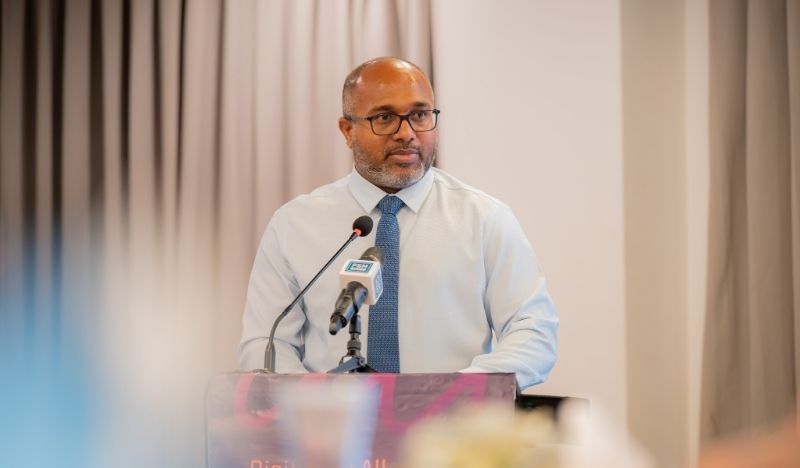
Photo: Maldives Innovation and Digital Company
Minister of Homeland Security, Labour and Technology Ali Ihusaan has raised concerns over suspected trade-based money laundering involving foreign currency issued by banks through Telegraphic Transfers (TTs) for imports, saying some of the goods linked to the transfers never enter the Maldives.
Speaking at a press briefing at the President’s Office on Monday, Ihusaan said information reviewed under a Memorandum of Understanding (MoU) between the Bank of Maldives and the Maldives Customs Service had identified cases where large-value TTs were made for imports without the corresponding goods subsequently arriving in the country.
advertisement

advertisement

According to the Minister, some parties have claimed the transfers were advance payments for goods. However, he said there were cases where the goods had still not arrived more than a year after the payments were made.
“What we have observed while working under the MoU signed between the Bank and Customs is that when certain individuals make large-value TTs, the goods corresponding to these TTs do not enter the Maldives. They claim it was paid as an advance payment, but even after a year, no goods arrive,” Ihusaan said.
He said that in other cases, parties had claimed the transfers were balance payments for goods previously imported. However, checks found that the goods listed on invoices submitted in support of those claims had not entered the Maldives either.
Minister Ihusaan described the practice as trade-based money laundering and alleged that the mechanism was being used in connection with drug trafficking and to transfer the earnings of foreign workers out of the country.
“This is called trade-based money laundering, and we are now noticing that this route is being used for drug trafficking and for sending foreign workers’ wages abroad,” he said.
The minister said cases identified through the process would be investigated as suspected criminal offences and action would be taken under laws governing trade-based money laundering.
He also stressed that individuals and businesses were required to comply with existing laws, saying a lack of enforcement in the past should not be interpreted as permission to engage in activities that constitute an offence.