

Maldives, China Prosecutors Sign New Cooperation Agreement on Prosecution
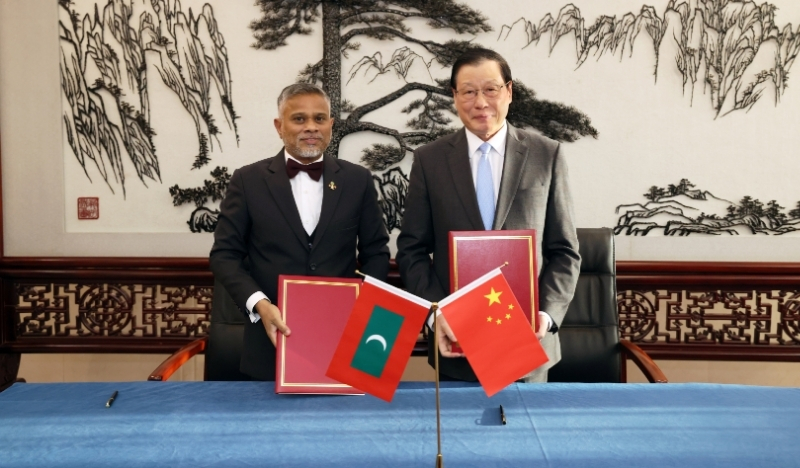
Prosecutor General Abbas Shareef with China’s Prosecutor General Ying Yong at the Supreme People’s Procuratorate (SPP) in Beijing.
Maldives and China have signed a new agreement to strengthen cooperation between their prosecution authorities, including in digital transformation and the use of artificial intelligence in prosecution.
Prosecutor General Abbas Shareef held official discussions with China’s Prosecutor General Ying Yong at the Supreme People’s Procuratorate (SPP) in Beijing, with deputy prosecutor generals and senior officials from both offices attending.
advertisement

advertisement

The discussions covered digital transformation and the use of artificial intelligence in prosecution, while the two sides also discussed strengthening existing cooperation between the SPP and the Maldives Prosecutor General’s Office (PGO).
Prosecutor General Justice (Retired) Abbas Shareef held official discussions with Prosecutor General of China Mr. Ying Yong at the Supreme People’s Procuratorate in Beijing today.
The two Prosecutor Generals held extensive discussions on digital transformation and the use of AI… pic.twitter.com/m5IcNf5CmI— Prosecutor General’s Office (@PGO_MV) September 14, 2026
Following the meeting, Abbas and Ying signed the Agreement on Cooperation between the Supreme People’s Procuratorate of the People’s Republic of China and the Prosecutor General’s Office of the Republic of Maldives.
The new agreement replaces a cooperation agreement signed by the two offices in May 2017.
Under the agreement, the two offices can assign prosecutors for professional research and training and cooperate or provide assistance in other areas mutually agreed upon. It also provides for the protection of confidential information exchanged under the agreement.
The agreement is intended to expand practical cooperation, professional development and the exchange of knowledge and experience between the two prosecution authorities.
The discussions come as the PGO advances its PGO 2.0 strategy, which includes a framework for the governance and use of artificial intelligence within the office.
According to the Prosecutor General, the strategy uses a two-layer system. The first establishes policies governing AI use, including principles applicable to all uses, rules on where case information may be transferred and requirements for human oversight depending on the AI tool.
The second layer consists of a tool register designed to assess and approve individual AI tools and establish conditions for their use without requiring the wider framework to be revised whenever a new tool is introduced.