

Census 2022 Results are Out!
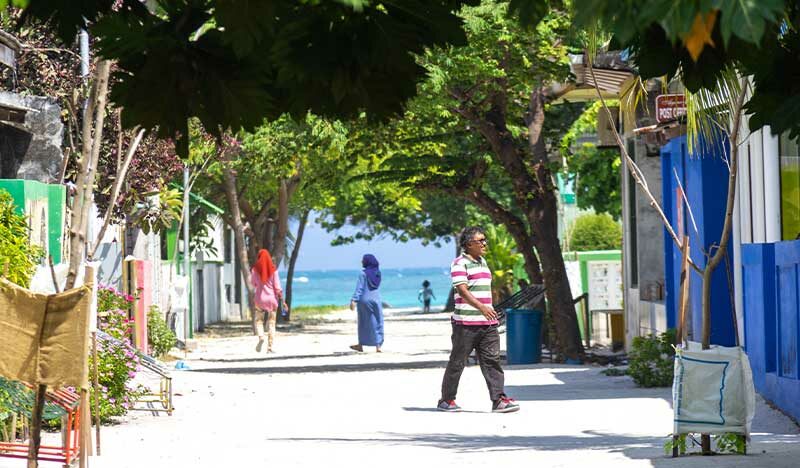
During the event held to commemorate World Population Day 2023 today, Maldives Statistics Bureau (MBS) released the latest CENSUS 2022 results for the Maldives, showcasing an interesting demographic landscape.
Here are a few highlights from the report:
Population: Maldivian vs Foreign:
advertisement

advertisement

Census shows that a total 515,132 people live in Maldives. This includes 382,639 resident Maldivians and 132,493 as resident foreigners.

Resident Population: Male’ vs Atolls:
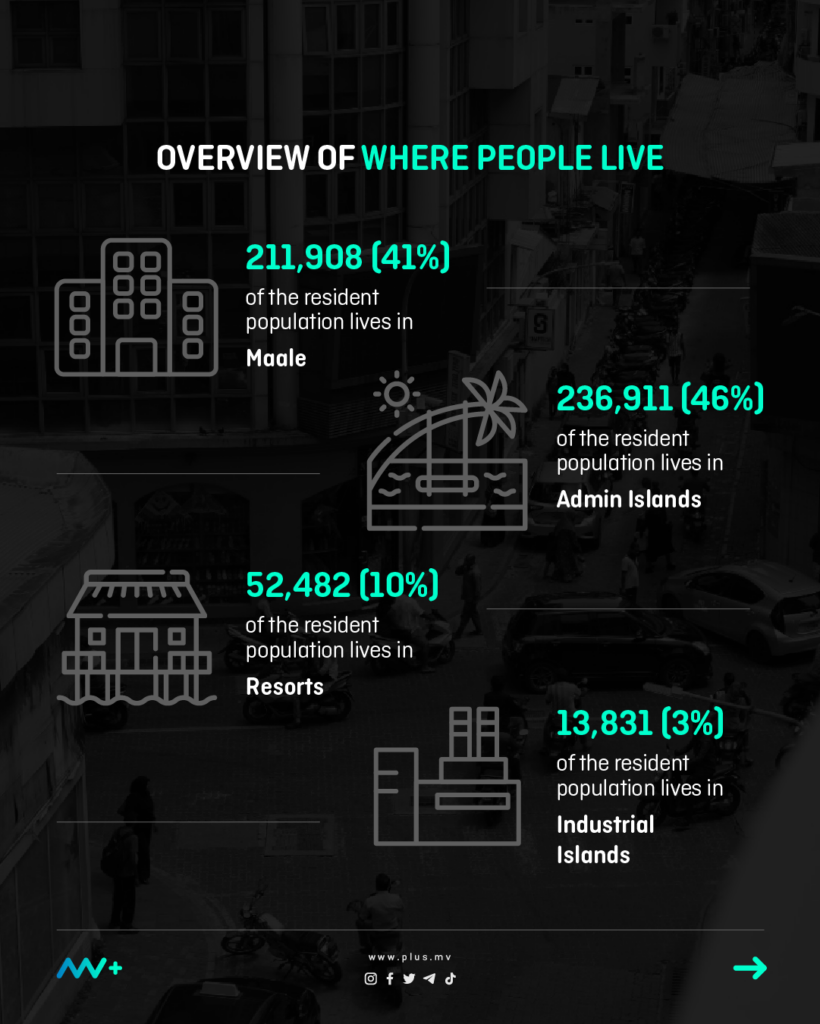
About 41% of the population lives in the Maale area (Maale, Hulhumale’,Villimale & Hulhule) while 46% of the resident population lives in the Admin islands and 10% of the resident population lives in resorts.
211,908 (41%) of the resident population lives in Male’
52,482 (10%) of the resident population lives in Resorts
236,911 (46%) of the resident population lives in Admin Island
13,831 (3%) of the resident population lives in Industrial Islands
Migration: migrants among resident Maldivians
Resident Maldivian is classified as a migrant if they have lived in a place other than their usual residence for 1 year or more. Census shows that 46% of the resident Maldivian population as migrants. (meaning they have lived somewhere else other than their usual residence for 1 year or more). And 40% of the migrants are resident Maldivians between the age of 25 to 39 years.
46% of the resident population are migrants of which, 46% are Male and 45% are Female.

Migration: Reason for migration among resident Maldivians
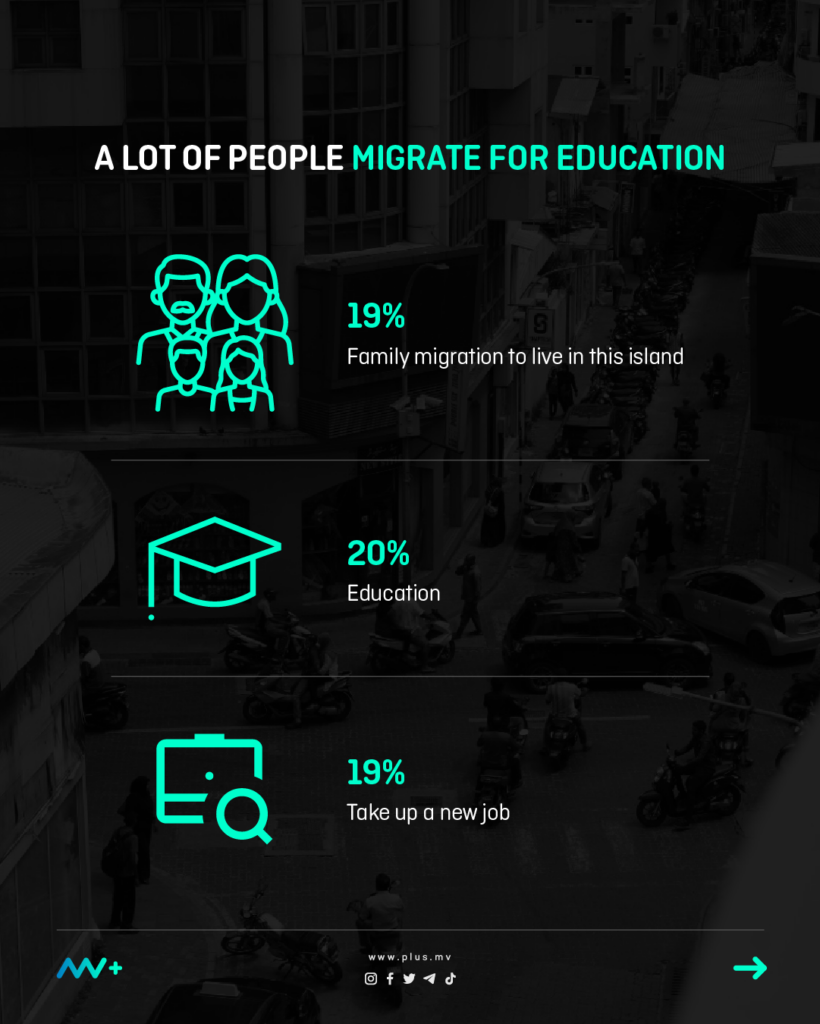
Among migrant Maldivians, most migrate for better education (20%), take up a new job (19%) and family migration to live on this island (19%). Migration towards Maale is for education(37%) and family migration takes precedent (21%) over migration for employment (14%). Migration towards Admin islands is mainly as return migrants (29%), family migration to live with family (21%) and due to marriage (13%).
Education: Literacy of the Resident Maldivians
Census shows that 98% of the population is literate in dhivehi. Among the Maldivian resident population 81% of the population aged 10 years above was literate in English. More men are literate in English compared to women.
Literacy : 81% English, 98% Dhivehi
Education: Currently studying population among Resident Maldivians
Census shows that 33% of the population is currently attending any school/ training institution. Among the school going population (6- 15 years) 2% of the children are currently not attending any school/ training.
Education: Highest educational attainment of Resident Maldivians
Among resident Maldivians who are 15 years and above, 39% of the population have attained secondary education (O’level) , followed by 18% having completed primary education About 10% of the population have an educational attainment with degree and above qualification.
Disability: Prevalence of disability among resident Maldivian
Census shows the prevalence of disability among resident Maldivian (5 years and above) as at 6.9 %. Disability prevalence is greater among women compared to men. The prevalence of disability is more in Admin islands compared to Maale. Note to display on screen: Census measured disability using Washington Group short set of questions used to capture functional difficulty Disability questions was asked for 5 years and above population
24,284 Population with disability: 13,415 Female, 10,869 Male
6.9% Prevalence of disability: 7.7% Female, 6.1% Male
Economic activity
The working age population of Maldives (15 years of age over) is 411،219 or (80%), of which 37% are females and 63% are males. Of the working age population (68%) are Maldivians and (32%) are foreigners.
Working age population [15 years of age over] – 411,219 (80%)

Economic activity: Labourforce
Census shows that the labour force participation rate of the resident population (15 years and above population) is at 64%. Huge differences exist in the labour force participation rate between men and women.
Labourforce Participation Rate 64%
Female 49%
Male 80%
Unemployment rate among Resident Maldivian
The unemployment rate for resident Maldivians stands at 5%. More female are unemployed compared to men. Note: Unemployed population is those who are seeking jobs and are available to start working
Unemployment Rate 5%
Female 6%
Male 5%
Economic activity: Employment by occupation
Among the resident Maldivian many are mainly working in accommodation and food service industry and public administration. Resident Foreigners work in accommodation and food service industry and then in construction industry
Accommodation and food service 15%
Public administration & defence 15%
MARRIAGE & FERTILITY
Marital Status: At the time of census, the majority (69%) of the resident Maldivians (15 years and above) were married , 9% as divorcees. About 19% of the resident Maldivians remain single (never married).
Never Married 19%
Married 69%
Divorced 9%
Widowed 3%
Average age at first marriage:
The average age at first marriage shows that women get married at the age of 20 years. Men get married 4 years later than women at the age of 24 years.
Age at first marriage: 22 years
Female : 20 years
Male : 24 yeras
Fertility: Total Fertility Rate (TFR)
Total fertility rate shows that average number of children a woman is expected to have during her reproductive span. The TFR for census 2022 records the lowest with women having 1.7 children on average. The average number of children a woman has has declined and has gone below replacement level fertility.
Household
Census 2022 shows a total of 94,424 households are there in the country. This includes 42,571 households in Maale and 51,853 households in the Administrative islands
Household: by type
81,744 households are in houses/flats/apartments and 74% of the resident population lives in them. About 1,056 households or 1% of the resident population live in places or buildings not intended for human habitation.
Household size (living in house/flats/ apartments) :
On average 4.7 people live in a household. Household size is 4.5 in Male’ and 4.8 in other administrative islands. When compared with 2014, one person has moved out from each household. In 2014, the average household for the Republic was 5.2.
In the Maldives, a population and housing census gets conducted at least once every ten years as is followed under the Maldives Statistics Act 41 (a).
The collection of census data holds immense significance due to its role as an indispensable tool for the development of a democratic society.
Through the census, a wide range of statistics can be generated, encompassing crucial aspects such as the economy, society, environment, and population within the Maldives. By conducting a comprehensive census, it becomes possible to evaluate the current state of the country and effectively disseminate this valuable information to the public and policymakers alike.