

Aasandha Poses Greater Financial Burden, Say MPs Debating Lifetime Health Benefits
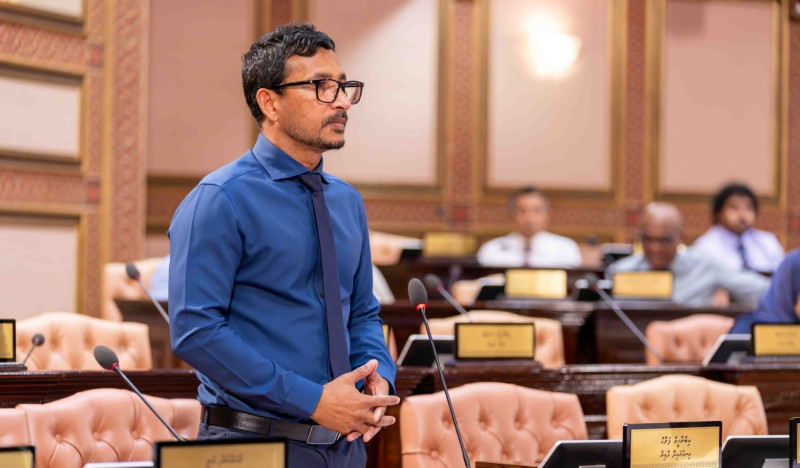
MP for Inguraidhoo constituency Ibrahim Falah, speaking at the parliament on July 28, 2026 | Photo: Parliament
Aasandha imposes a heavier direct financial burden on state coffers than private parliamentary coverage, lawmakers argued during a Majlis debate on a public petition seeking to end lifetime medical insurance for current and former Members of Parliament.
The petition, submitted on 12 August 2026 by Midhuam Sa’ud calls for amendments to Parliamentary Privileges and Powers Act. Under the Act, sitting MPs, their spouses, dependent children under 18, and all former parliamentarians are entitled to private health insurance covering medical treatment across the Maldives, SAARC, and ASEAN nations encompassing 19 countries, including Malaysia, Thailand, and Singapore.
advertisement

advertisement

According to figures cited in the petition, approximately MVR 100 million was spent on parliamentary health insurance premiums between 2015 and 2025.
The petitioner argues that granting lifetime private healthcare coverage to lawmakers creates an unfair disparity with ordinary citizens, who rely on the state-run Aasandha and NSPA welfare systems, while reducing incentives for MPs to reform national health infrastructure. The petition advocates transitioning lawmakers to the standard national scheme.
Defending the current framework during parliamentary debate, lawmakers highlighted the cost distinction between fixed private insurance premiums and uncapped state health liabilities.
“Within our annual insurance package, up to MVR 1.35 million can be spent on a Member of Parliament. However, that does not mean MVR 1.35 million comes directly from the state budget. The state budget pays only MVR 24,000 per year to the insurance company for each MP,” argued MP Falah. He added that under the universal Aasandha system, the state directly absorbs catastrophic medical costs that can reach millions of Rufiyaa per patient. “Therefore, we need to examine which system poses a greater financial burden on the state.”
Eydhafushi MP Ahmed Saleem similarly noted that fixed premium payments represent a predictable administrative cost within established state frameworks. “Looking at the monthly rate, the government spends just MVR 2,000 on each member,” Saleem stated, noting that benefits are disbursed by private insurers rather than directly from state coffers once premiums are paid. “We could survive without insurance, or even without a salary. However, the state has established structures and rules, and certain benefits are defined within those rules.”
Funadhoo MP Mohamed Mamdooh added that while he supports reducing state expenditure, the petition relied on selective international examples to support its arguments.
However, other parliamentarians across party lines raised serious concerns regarding public inequality, institutional performance, and systemic flaws in the national healthcare system.
Opposition MP Ahmed Shamheed of South Hulhumalé emphasised that the issue centers on social inequality and equal rights to healthcare. “We know that if someone on a small island suffers a heart attack, their survival rate is low,” Shamheed noted, adding that no Maldivian citizen’s life should be categorized or valued differently in the eyes of the state.
Kanditheemu MP Ameen Faisal argued that the petition highlights broader failures in public welfare, as citizens are currently forced to beg for charity when facing illness due to the inadequacies of Aasandha and NSPA. While stating he does not support receiving privileges denied to ordinary citizens, Ameen observed that private insurance schemes are not unique to Parliament, pointing out that state-owned enterprises, the police, the MNDF, and the judiciary enjoy similar arrangements.
MP Mauroof Zakir of Kendhoo constituency acknowledged public frustration over unequal benefits amid widespread shortages of medication and basic medical services, stressing that MPs must take responsibility for addressing public concerns.
Galolhu South MP Mikael Ahmed Naseem linked the public backlash directly to parliamentary performance and independence. “If the public perceives this Parliament as failing to perform and functioning as nothing more than a small desk of the President’s Office, they will not believe that members deserve their salaries, allowances, or health insurance,” Naseem stated.
Addressing the floor, Speaker of Parliament Abdul Raheem Abdulla clarified that the petition was accepted for parliamentary consideration because established mechanisms for citizens to submit e-petitions are now active.
The floor concluded the initial debate stage for today, with the next parliamentary sitting scheduled for tomorrow at 09:00.