

BML Establishes MVR Card E-Commerce Spending to USD 16 Million Monthly
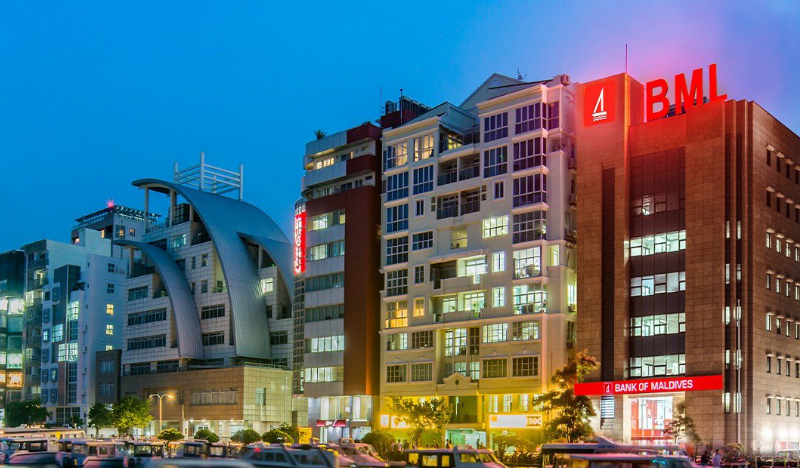
Customers may then try again or use a card linked to a US dollar account, where available. | Photo: BML
International online payments made using Bank of Maldives cards linked to Maldivian rufiyaa accounts are now subject to shared daily dollar allocations under a framework that provides up to USD 16 million a month for e-commerce transactions.
The system means that having money in an account and room within a cardholder’s personal foreign spending limit will not always be enough for a payment to go through. A transaction may be declined if the bank-wide allocation for that merchant or category has already been used for the day.
advertisement

advertisement

Earlier public explanations issued when BML introduced controls in May said daily budgets would apply to selected international websites. However, those explanations did not provide the category-by-category values and reset time contained in the latest framework. Customers now have a clearer picture of how the shared allocations operate.
What is changing?
BML has divided up to USD 16 million a month among different types of international e-commerce payments made with MVR cards. Each category will have an indicative daily limit shared by all customers, rather than a separate daily allowance for every cardholder.
BML said its MVR cards are used across more than 40,000 international e-commerce platforms and now process more than 20,000 such transactions on an average day.
If the pool for a category or particular merchant is exhausted, further transactions in that group may be declined until the limits reset at 7am the next day. Customers may then try again or use a card linked to a US dollar account, where available.
How will the USD 16 million be divided?
The largest allocation, USD 6 million a month or around USD 200,000 a day, is reserved for airline tickets, hotel bookings and other travel-related payments.
The 150 most frequently used international e-commerce merchants, including platforms such as Temu, Alibaba, Apple and Amazon, will share USD 3 million a month, equivalent to approximately USD 100,000 a day. BML has published the full list on its website.
Essential subscriptions and other services identified by BML as vital will receive another USD 3 million a month, also around USD 100,000 a day. Social media platforms, including Facebook, Instagram and TikTok, will share USD 1.5 million a month, or about USD 50,000 a day.
All remaining international e-commerce merchants will share USD 1.8 million a month, equivalent to roughly USD 60,000 a day. BML described this pool as primarily covering discretionary and non-essential spending.
The five published category allocations total USD 15.3 million. BML said health and education transactions will be supported through a dedicated buffer within the overall USD 16 million allocation, but it has not stated a fixed value for that buffer.
How does the new allocation compare with recent spending?
At a BML event in June, Chief Executive Officer and Managing Director Mohamed Shareef said overseas purchases and services made through MVR cards averaged USD 39.3 million a month. Reporting from the event placed the e-commerce share at 65 percent, or approximately USD 25.5 million a month.
Compared directly with that reported average, the USD 16 million allocation is USD 9.5 million lower, a difference of about 37 percent.
The comparison requires caution. The earlier figure was an average of e-commerce spending reported by BML, while the new figure is an allocation under the category-based framework. BML has not published a reconciliation confirming that both figures cover precisely the same transactions. The 37 percent figure should therefore be read as the difference between the two published amounts, not as a confirmed reduction for every customer or category.
BML has also said the new e-commerce allocation does not represent a reduction in the overall amount of foreign currency it provides across all customer services. The USD 16 million figure applies specifically to international e-commerce transactions made using MVR cards.
Why is BML imposing the limits?
BML said the dollars needed to settle international card transactions have grown beyond the foreign currency available through its funding channels. The bank said this has placed pressure on its ability to meet other foreign currency requirements, particularly Telegraphic Transfers, where customers are already experiencing delays.
The bank is seeking to preserve more of its available foreign currency for essential goods and services while managing discretionary online spending. A customer’s rufiyaa balance does not remove BML’s need to source the US dollars required to settle an international card transaction.
Are health and education payments exempt?
Health and education transactions will not be subject to a separate merchant-level or category ceiling. BML said it will maintain a dedicated buffer to keep these payments available and adjust it where necessary.
They are not outside the overall system, however. The bank has stated that health and education payments will still be processed within the total monthly e-commerce allocation of USD 16 million. The absence of a category limit therefore does not mean an unlimited supply of dollars is available for these transactions.
What is the new restriction on travel bookings?
In addition to the shared USD 6 million travel pool, each customer will be limited to three transactions with travel and accommodation merchants during a three-month period.
BML said foreign currency outflows had risen as some customers purchased tickets and accommodation on behalf of other people. The bank said the transaction limit is intended to preserve access for customers meeting their own travel requirements.
BML described the restriction as three transactions, rather than three journeys. The notice does not provide further detail on how the transaction count will be applied.
Does this replace a customer’s existing card limit?
BML’s website separately lists a monthly e-commerce limit of USD 250 for MVR debit cards, with a limit of up to USD 3,000 for hotels, airlines and medical payments. The new notice does not announce any change to those customer-level limits.
Customers may therefore remain subject to their applicable card limit as well as the availability of money in the relevant shared daily allocation. The notice also does not address whether the separate limit of 30 e-commerce transactions per customer, announced in May, remains in effect.
How transparent is the new system?
The disclosure provides more detail than the public explanation of the earlier arrangement. When BML introduced daily budgets for selected platforms in May, customers were told that payments would stop once a daily allocation was exhausted. The explanation released at the time did not set out the category-by-category dollar amounts now available.
Customers now know the overall allocation, the main category pools and the reset time. BML has also published the 150 merchants covered by the main e-commerce category.
Some uncertainty remains because the limits are shared across the customer base. The notice does not state whether customers will be able to see the balance remaining in a category or merchant allocation in real time. The bank has also described the daily limits as indicative and said it will review allocations according to transaction volumes, usage patterns and available foreign currency liquidity.
For customers, the immediate effect is that an online payment may depend not only on their own account and card limit, but also on how much other BML customers have already spent in the same category that day.