


ESCAP Workshop Explores Data-Driven Social Protection in Maldives
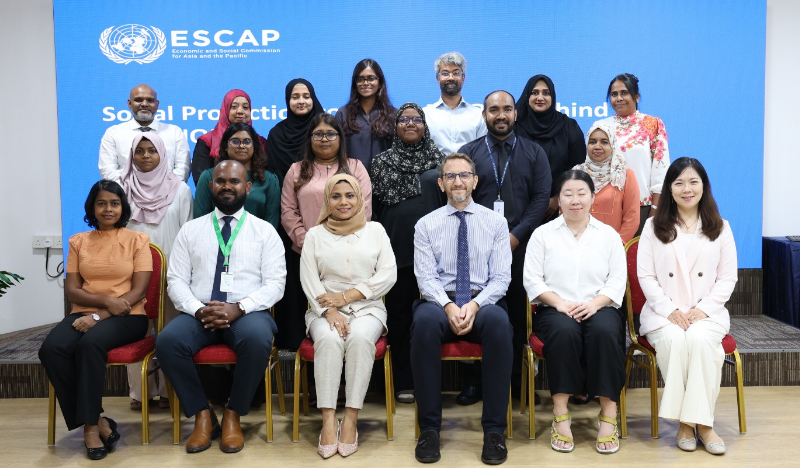
NSPA considered the possible effect of increasing the single-parent allowance on recipient households. | Photo: UN Maldives
The Maldives has begun a technical review of social protection gaps using household and census data, with policymakers examining how targeted measures could address inequalities affecting vulnerable groups.
The four-day workshop, held in Malé from 9 to 12 August, was organised by the United Nations Economic and Social Commission for Asia and the Pacific in partnership with the Ministry of Health, Family and Welfare.
advertisement

Thirteen policymakers and technical specialists from the National Social Protection Agency, Maldives Pension Administration Office, Maldives Bureau of Statistics, and national planning bodies took part in the programme.
Participants reviewed ESCAP’s data-based policy tools, including the Leaving No One Behind Platform, the Social Protection Online Toolbox Simulator and the Social Protection to Leave No One Behind application.
Using policy questions developed jointly by local experts and ESCAP, participants adapted the tools to analyse household survey data and information from the 2022 Census. The exercise aimed to identify groups facing the greatest disadvantages and assess how social protection measures could reduce vulnerabilities.
The National Social Protection Agency considered the possible effect of increasing the single-parent allowance on recipient households. Pension officials examined disparities among older persons in digital access, literacy, education and employment.
Officials from the Maldives Bureau of Statistics and the Ministry of Health, Family and Welfare also assessed gaps in access to basic services, considering factors including age, gender, location, migrant status and disability.
The workshop produced policy recommendations that were discussed with senior managers to determine next steps. ESCAP and Maldivian focal points are expected to develop knowledge products outlining the findings and recommendations to support evidence-based social development policy.
Government representatives are also expected to present the work at regional and global events planned for 2027, contributing to South-South collaboration on inclusive social development.