

Government Introduces Maldives 2.0 Digital Transformation Bill to Parliament
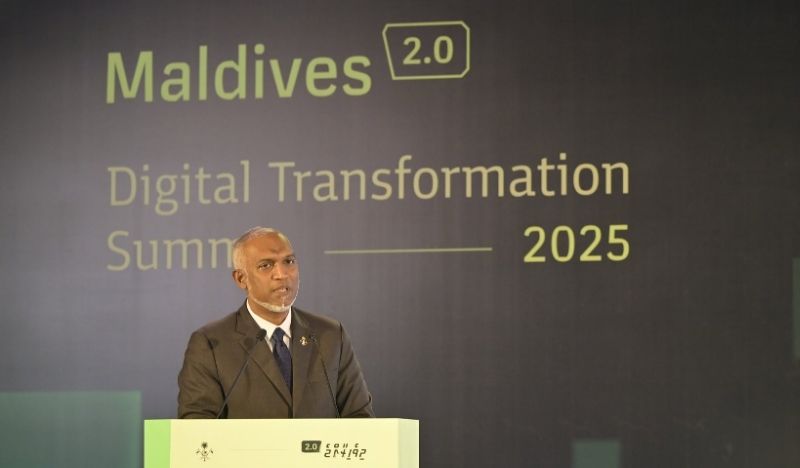
President Dr Mohamed Muizzu speaking at the Maldives 2.0 Summit on May 10, 2025 | Photo: Maldives 2.0 Meta page
The government has submitted the “Maldives 2.0” Digital Transformation Bill to the parliament, setting out plans to establish a unified digital governance system for state services.
The bill, sponsored by MP Mohamed Ali for the Gadhdhoo constituency on behalf of the government, aims to restructure public administration under a “digital first” approach. It seeks to deliver government services in a secure, reliable and sustainable manner through a coordinated digital system. The first debate regarding the bill was held today.
advertisement

Maldives Digital Service to Oversee Implementation
The legislation proposes the establishment of a new entity, the Maldives Digital Service, which will operate under the Ministry of Internal Affairs.
Under the bill, the institution will assume responsibility for state information and communications technology services, as well as the management of national digital infrastructure and networks. Existing digital service functions, employees and responsibilities under the ministry will be transferred to the new body.
The Minister of Internal Affairs will remain accountable to the parliament for the institution’s performance.
The Maldives Digital Service will also set technical standards for digital public services to ensure accessibility, reliability and consistency across government institutions.
“Maldives 2.0” Programme and Digital First Policy
The bill introduces a national programme titled “Maldives 2.0”, designed to guide the country’s broader digital transformation strategy.
It requires all state services to align with a “digital first” policy and establishes a central framework to manage the transition. The programme also sets out governance structures to oversee implementation and ensure coordination across state institutions.
Integrated Systems, Digital Identity and Data Governance
The proposed framework includes the development of interoperable systems to enable seamless data exchange between government institutions.
It also provides for the introduction of a digital identity system to support secure transactions and service delivery. The bill outlines the creation of data registries to verify authenticity across systems and establish structured data classification standards.
In addition, it sets out provisions for secure data-sharing frameworks to improve efficiency and reduce duplication across public services.
Sovereign Cloud Infrastructure and Compliance Monitoring
The legislation includes plans to establish a sovereign cloud infrastructure to host state data and digital systems. It also outlines compliance monitoring mechanisms to ensure adherence to standards and governance requirements.
Parliamentary Debate Highlights Concerns Over Data, Capacity and Security
During the first reading of the bill in the People’s Majlis, MPs presented contrasting views on the proposed digital transformation framework, focusing on data protection, technical readiness and national security implications.
Dr Ahmed Shamheed, MP for South Hulhumalé, raised concerns over the extent of government access to citizens’ personal data under the proposed system. He questioned whether the bill provided sufficient safeguards for individual privacy, highlighting the absence of clear opt-out provisions for the sharing of personal information.
MP for Kendhoo, Mauroof Zakir, supported the bill’s objectives but questioned whether the Maldives currently has the technical capacity to implement and maintain a secure national digital system. He cautioned that cybersecurity risks and infrastructure limitations needed careful consideration before implementation proceeds at scale.
Parliamentarian for the Dhaandhoo constituency, Mohamed Fazeel, backed the legislation, citing the growing reliance on digital systems across society and the increasing threat of cyberattacks. He pointed to past incidents affecting government-linked entities, including cases involving financial losses linked to cyberattacks and blackmail schemes, as justification for stronger digital safeguards.
Hanimaadhoo MP Abdul Ghafoor Moosa called for wider consultation before the bill progresses further. He urged lawmakers to engage with business leaders and other stakeholders to better assess the practical implications of the reforms and emphasised the need for clear accountability mechanisms to address potential misuse of data or systems.
South Machangolhi MP Ibrahim Mohamed supported the bill, highlighting the increasing role of technology in public life. He argued that stronger legal frameworks were necessary to protect national security and ensure that the country adapts to its growing digital landscape.