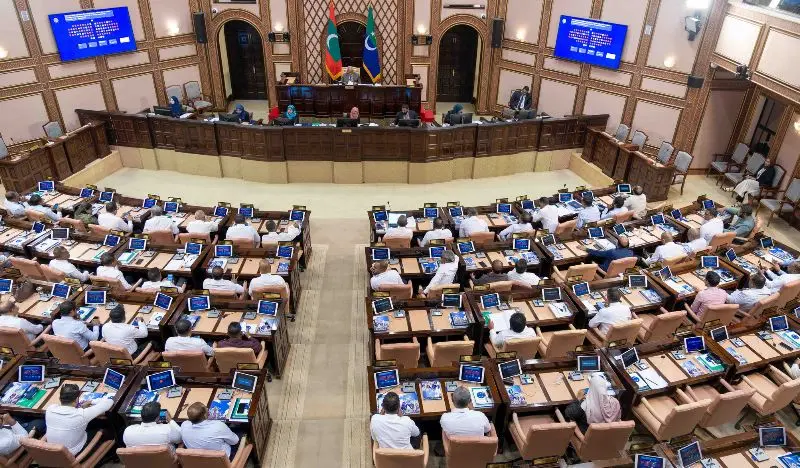


The Government has submitted a bill to the People’s Majlis proposing sweeping amendments to the Maldives Customs Act that will bring Customs’ revenue collection, accounting, and financial regulations directly under the policy oversight and directives of the Ministry of Finance.
Sponsored on behalf of the Government by Bilehdhoo MP Hassan Zareer, the legislation aims to ensure that the collection, recovery, accounting, and reporting of state revenue by Customs officers are conducted strictly in alignment with the State’s national fiscal policy.


The central pillar of the amendment grants the Minister of Finance the statutory authority to issue binding revenue administration policies, directives, and circulars to Customs.
Under the new Section 72-1, Customs will be legally required to follow the Finance Minister’s directives and advice across four key financial operations: collecting import duties, taxes, and other state revenues; identifying and accounting for unpaid duties and taxes owed to the State; offsetting overpaid duties and taxes against amounts receivable by Customs; and granting exemptions on the payment of duties, taxes, and other revenues.
To enforce this oversight, the bill establishes stricter internal controls and mandatory reporting. Under Section 72-1(b), Customs must establish formal procedures and issue regular notifications on tracking receivables, monitoring unpaid state revenue, and verifying eligibility before issuing tax or duty refunds.
Furthermore, Section 108-2 mandates that Customs maintain detailed records of all duties, taxes, service fees, fines, and other revenues collected, along with how those funds are collected, utilized, or expended and submit them to the Ministry of Finance in a manner prescribed by the Minister.
The legislation also extends ministerial influence over Customs’ regulatory and budgeting processes. Amendments to Sections 63 and 103 require that regulations governing the valuation of goods and the auctioning of seized or unclaimed goods be formulated in accordance with the advice of the Finance Minister.
Meanwhile, under the new Section 23-1, while Customs’ operational funds will continue to be allocated annually in the State Budget passed by Parliament, the agency’s annual budget must be prepared under the Public Finance Act and submitted to the Finance Ministry in consultation with the Commissioner General of Customs.
Once passed by Parliament, ratified, and published in the Government Gazette, the Act will take immediate effect. All corresponding amendments to existing Customs regulations, as well as any newly required regulations, must be drafted and gazetted within 90 days of the law coming into force.