

Government Pursuing Holistic Response to Drug Problem, Says President Muizzu
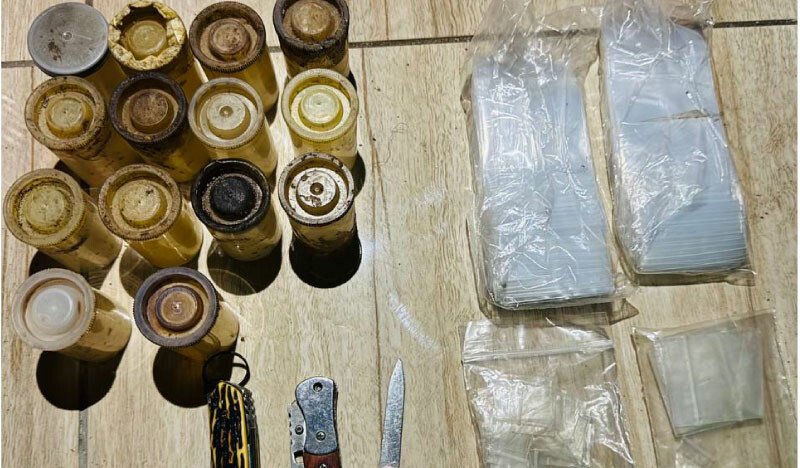
Some of the items seized in the nationwide drug operation by the Maldives Police Service on Thursday, November 13, 2025| Photo: Maldives Police Service
President Dr Mohamed Muizzu has said the government’s policy on drug control is based on a holistic approach aimed at addressing the root causes of substance abuse and rehabilitating affected individuals.
Speaking on the third episode of The Pulse podcast released on Thursday, the President said the government’s approach focuses on rescuing young people affected by drug addiction and supporting their reintegration into society as productive citizens.
advertisement

The episode, which centred on national efforts against narcotics, featured questions from The Press and was presented as a platform where the President discusses key public policy issues with Chief Government Spokesperson Mohamed Hussain Shareef (Mundhu). The discussion followed the marking of International Day Against Drug Abuse and Illicit Trafficking last Friday.
President Muizzu said drug abuse cannot be tackled through isolated interventions, adding that underlying factors such as housing constraints, employment opportunities, income generation, education, healthcare access, and broader development policies contribute to vulnerability among young people.
He said the government is working across these areas through job creation, small business support, women’s income-generation initiatives, and improvements in health and education services, describing these as part of a wider strategy to address the drivers of drug abuse and related crime.
The President also said work is underway on a modern rehabilitation and reintegration facility for young offenders, to be developed at a designated site in Uthuru Thila Falhu (UTF). He said the project is costly but necessary, adding that proposal evaluations are ongoing and that implementation is expected to begin during the current presidential term.
The remarks come in the context of major amendments to the Drugs Act passed by Parliament in December 2025 and ratified shortly after, which introduce stricter penalties for serious drug trafficking offences, expand enforcement powers, and allow for the possibility of the death penalty in narrowly defined cases requiring a unanimous Supreme Court decision.
Under the amended law, life imprisonment applies for serious offences, plea bargaining has been removed for the most severe cases, and authorities have been granted expanded powers for asset seizure and enforcement actions linked to drug-related crimes.
The policy discussion also follows a joint statement issued by international and local rights organisations in April, including Human Rights Watch, calling on the government to withdraw proposed legislation to end the Maldives’ moratorium on the death penalty and to repeal amendments to the Drugs Act permitting capital punishment.
The groups warned that the measures could conflict with international obligations under the International Covenant on Civil and Political Rights, which the Maldives acceded to in 2006, and United Nations resolutions urging restrictions on the use of capital punishment.