

Housing Minister Responds to Concerns Over USD 20 Billion Rasmalé Project
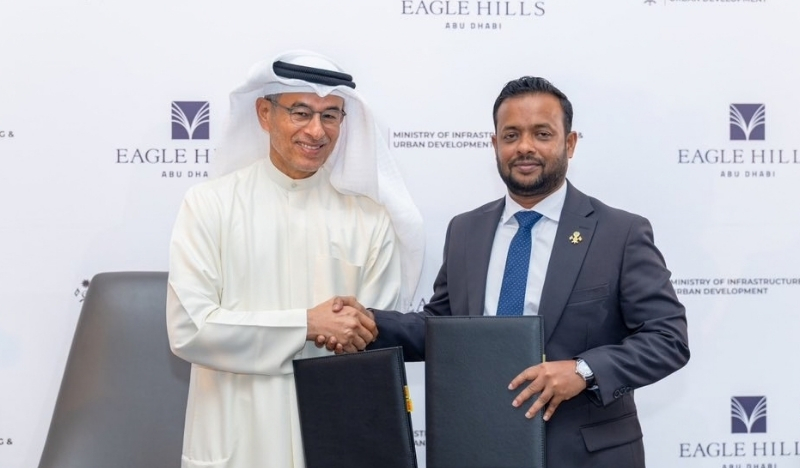
Emaar founder Mohamed Alabbar and Minister of Infrastructure, Housing and Urban Development Abdulla Muththalib.
Housing Minister Abdulla Muththalib has responded to public concerns over the government’s more than USD 20 billion Rasmalé waterfront and marina project, defending the agreement’s financial structure, housing commitments and provisions governing foreign property ownership.
Muththalib addressed the concerns in a LinkedIn post following the government’s signing of a commercial terms agreement with UAE-based Eagle Hills in Dubai, which he described as the largest foreign investment programme in Maldivian history.
advertisement

advertisement

Responding to concerns that the Maldives should receive a substantial upfront payment, Muththalib said the agreement instead provides the state with recurring revenue from economic activity generated by the development.
He said the government will receive Tourism Goods and Services Tax (TGST) on hotel stays, meals, shops and services, a 10 per cent share of revenue from the master developer and four per cent from property transactions.
Muththalib also said all sale proceeds from properties in Rasmalé will be held in an escrow account in the Maldives, while project funds will flow through Maldivian banks.
According to the minister, the government expects the project to generate more than USD 11 billion in state revenue over its development period and more than 54,000 jobs. He said the project is expected to attract at least one million visitors annually once it reaches maturity in about 10 years.
He said the government would not take a loan, provide a sovereign guarantee or grant tax concessions under the agreement.
Housing component
Responding to calls to prioritise housing in Hulhumalé instead of developing Rasmalé, Muththalib said the agreement covers both.
He said Eagle Hills will build 5,000 three-bedroom homes in Hulhumalé for Maldivian families at an estimated cost of USD 400–500 million.
According to Muththalib, Eagle Hills will finance the construction upfront, with the cost later deducted from the government’s share of project revenue rather than being financed through government borrowing.
He also said 500 hectares, or half of Rasmalé, will be reserved for local residential development. The minister said the area could accommodate a population of more than 150,000, while the commercial and tourism components on the remaining land would provide jobs and services.
Meanwhile, Finance and Public Enterprises Minister Hassan Zareer separately said Eagle Hills will construct 5,000 housing units in Hulhumalé at an estimated value of USD 500 million, with construction expected to begin in the first quarter of 2027.
Speaking on state media’s Raajje Miadhu programme, Zareer said the housing component forms part of the wider Maldives Waterfront and Marina project and would not require an upfront financial commitment from the government.
He said Eagle Hills would construct the units, after which ownership of the completed housing units would be transferred to the government.
Foreign ownership and sovereignty
Addressing concerns over foreign ownership of properties in Rasmalé, Muththalib said the project would not introduce freehold ownership or alter existing immigration and citizenship laws.
He said Maldivian laws and regulations would apply throughout the development and that the government would retain authority over property purchases and visas.
“There is no pathway – and there will never be a pathway – from owning a property to permanent residency or citizenship,” Muththalib said.
He added that the developer would not receive payments from the state based on passenger numbers or other similar charges, saying its revenue would come from the properties and developments it builds and sells.
Defence of reclamation
Muththalib also rejected criticism that the reclamation associated with Rasmalé amounts to a waste of public money.
He argued that the main challenge facing reclaimed land in the Maldives is not reclamation itself but the high cost of providing roads, electricity, water and sewerage to undeveloped areas.
He said the Rasmalé agreement would bring private capital to develop the reclaimed land and create an economic base capable of generating revenue for public services.
Muththalib linked the project to the government’s broader efforts to increase state revenue and reduce reliance on borrowing, saying the Maldives needs greater economic diversification and new sources of revenue.
Eagle Hills track record
Addressing concerns over whether the project would ultimately be completed, Muththalib pointed to Eagle Hills’ previous developments, including Downtown Dubai and Belgrade Waterfront.
He said the government would maintain transparency throughout the process and called on the public to allow the project time to demonstrate its progress.
The government signed the commercial terms agreement with Eagle Hills on Monday for the development of the Rasmalé waterfront and marina, a major mixed-use development planned on reclaimed land south of Malé.