
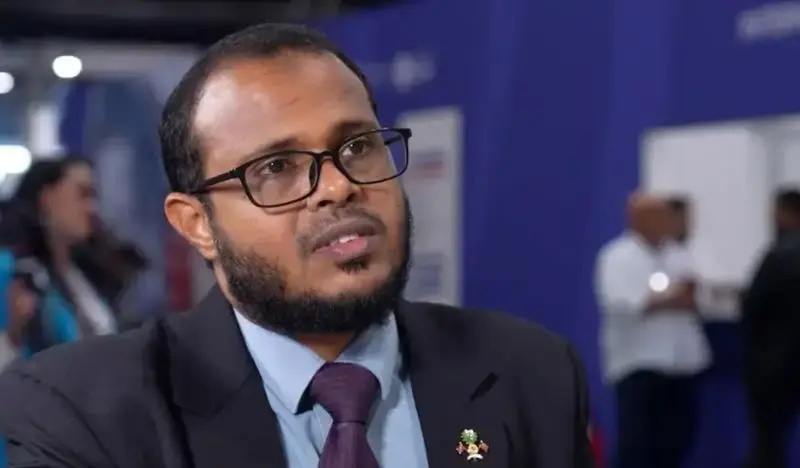
Minister of Climate Change, Environment and Energy, Ali Shareef, stated that the international community must provide small island nations with viable energy alternatives before pushing to phase out fossil fuels, warning that the Maldives refuses to be “left in the dark.”
Speaking in an exclusive interview with German broadcaster Deutsche Welle (DW), Minister Shareef highlighted that climate change is already severely impacting Maldivians’ daily lives and livelihoods. He noted that heavy rainfall last month forced families to evacuate their homes and caused widespread economic losses, while warming oceans are reducing fish catches and coral bleaching is threatening the vital tourism sector.


Reflecting on 31 years of Maldivian participation in UN COP climate summits, the Minister described the Paris Agreement as an encouraging symbol of global unity. However, he stressed that the pace of progress remains far too slow for vulnerable nations. Despite contributing minimally to global warming, small island developing states continue to bear the brunt of its consequences, he said.
Addressing the transition away from fossil fuels, he explained that the Maldives’ scarce land area makes it impossible to meet national electricity demand through rooftop solar panels alone, making ocean-based floating solar systems the primary solution.
“Unlike countries such as Germany that have calm, enclosed lakes and rivers, the Maldives has to install solar panels in the open ocean where they can withstand large waves and strong currents,” Shareef said.
He emphasised that while the Maldives is not opposed to phasing out fossil fuels, it must first establish reliable alternative infrastructure to guarantee uninterrupted power for citizens.
“We do not want to live in the dark. Those days are behind us,” the Minister stated. “The entire population needs electricity to live and progress. Becoming carbon neutral simply by halting oil use and leaving citizens in the dark is not a workable approach.”
On the UN climate negotiation process, he acknowledged that reaching consensus among nations with differing priorities is challenging, but argued that collective agreement remains essential. Rather than replacing the current COP framework, he called for strengthening and reforming existing mechanisms.
The Minister also reiterated the Maldives’ appeal for easier access to climate finance for small nations, adding that funding from major economies alone is insufficient and urging the creation of an enabling environment to attract private-sector investment into the renewable energy transition.
Minister of Climate Change, Environment and Energy Ali Shareef speaks to Deutsche Welle (DW) at COP31, discussing the Maldives’ transition to renewable energy, the challenges of moving away from fossil fuels, and the urgent need for global climate action. Watch the full interview with DW. 🔗 https://t.co/eIYYTFwBoL— Min. of Climate Change, Environment and Energy, MV (@MoEnvmv) November 20, 2026