

Malé Mayor Links Foreign Labour Use at Market to Unreliable Local Attendance
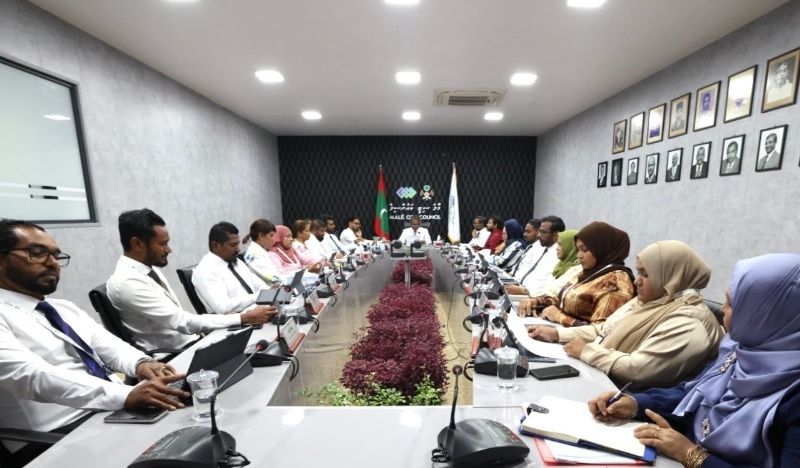
Photo: Malé City Council
Many local employees hired by businesses fail to consistently show up for work, leading vendors at the Malé local market to hire foreign workers, Malé City Mayor Adam Azim said.
Speaking during a City Council meeting on Wednesday, Azim said many vendors operating at the market are elderly and face difficulties in maintaining stable staffing for their businesses.
advertisement

He noted that inconsistent attendance among local workers has affected day-to-day operations, prompting some businesses to rely on foreign employees to keep operations running.
“Right now, there are very elderly people in those places, and they aren’t getting any employees. They can’t find Maldivian employees. When they do get them, they come one day and don’t show up the next, so they can’t run a business. This is a problem that has affected every single place,” Azim said.
Azim’s comments were made during discussions on market operations and broader labour challenges affecting small businesses in the city, after another member expressed concern over foreign nationals operating as shopkeepers, arguing that this contradicts existing regulations and calling for stricter enforcement.
Council members also debated the management of the Vilimalé market, including proposals to reform stall allocation procedures and address concerns over misuse of leased spaces.
One proposal called for extending rental agreements for vendors with consistent payment records, while another suggested introducing a competitive bidding system supported by a points-based evaluation framework to prioritise regular businesses.
Concerns were also raised over reported non-use of stalls, informal subletting and limited availability of locally produced goods. One council member highlighted that only nine out of 20 plots are currently in use, suggesting improved allocation could enhance market activity.
The Mayor, however, said enforcement challenges persist due to informal employment arrangements and a lack of documentation, where workers are often presented as employees of leaseholders.
The council indicated that current rental agreements may be temporarily extended while a broader review of allocation policies is carried out. Members also discussed the need to finalise a revised framework before issuing new contracts, aiming to balance enforcement priorities, labour market realities and efficient use of market space.