
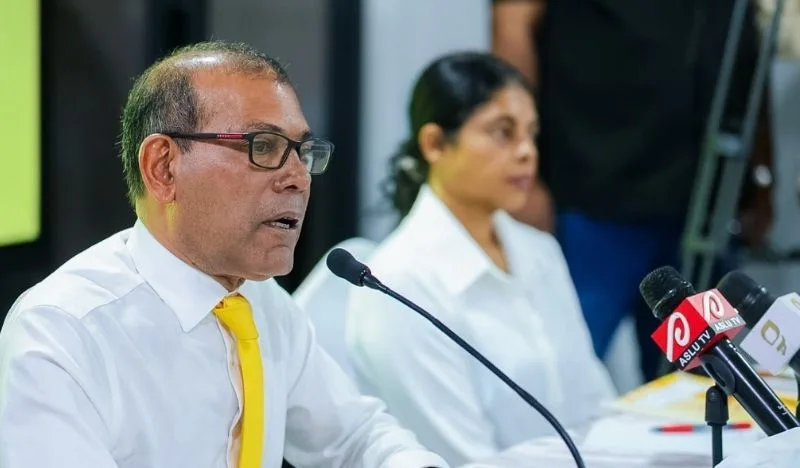
MDP Chairperson Mohamed Nasheed has defended foreign direct investment as a driver of economic development, arguing that countries which attracted foreign investment after colonial rule were better able to strengthen their economies and protect their independence.
In a post on X, Nasheed cited Singapore and South Korea as examples, saying foreign investment had not compromised their sovereignty but had instead helped them build stronger economies and secure their positions internationally.


He argued that investment should go beyond extracting raw materials and contribute to domestic processing and productivity.
Isthiumaaree alhuvethikan dhuh gaumuthakuge therein tharaqqee kashavaru kurevunee foreign direct investment ah marhaba kee gaumuthakah. E investment akee raw material negun ekani kamah vegenneh nufudhey. E process koh, ufehdhuntheri kamah magufahi vun laazim. Singapore nuvatha South Korea ge minivan kamah nuvatha istiqlaalah foreign direct investment akun asareh nukurey. Eyge badhalugai e gaumuthakuge iqthisoadhu varugadhave, e baarugai isthiqlaal himaayaiy kurumuge fanvaru libi, bainal aqvaamee dhandugai jaaga kashavaruvi.— Mohamed Nasheed (@MohamedNasheed) November 15, 2026
His remarks came two days after opposition parties and political figures joined a rally at Artificial Beach in Malé calling for the government to halt the Ras Malé project or hold a public referendum on the agreement with Eagle Hills.
The rally, organised under the banner “Dhivehinge Bin Dhivehinnah” (Maldivian Land for Maldivians), was attended by former President Abdulla Yameen, former Vice President Faisal Naseem and former MDP chairperson Fayyaz Ismail.
Fayyaz, whom Nasheed has endorsed as the MDP’s presidential candidate for the 2028 election, attended the rally alongside other MDP members. However, he did not address the gathering. Nasheed himself was absent.
The government signed a commercial terms agreement with Eagle Hills on 21 September for a development envisioned to involve around USD 20 billion in investment across multiple phases. The project is planned for 500 hectares of reclaimed land at Fushidhiggaru Falhu, which the government has agreed to lease to the company for 99 years.
Nasheed has previously expressed support for the project while raising concerns about its immediate financial benefits and the long-term use of state assets.
In September, he said the waterfront development was a good idea but would not help address the Maldives’ immediate financial difficulties, arguing that it could take at least two years for the state to receive returns. He also called for the sale of state assets to generate funds more quickly.
He later urged the government to submit the Eagle Hills agreement to Parliament, citing the absence of an advance payment and the decision to locate the development in the Greater Malé area as concerns requiring clarification.
His position contrasts with the MDP’s formal stance. The party has called for the full terms of the agreement to be disclosed, raising concerns about the 99-year lease, the financial commitments made by the state, possible concessions to the developer and whether the arrangement could lead to foreign ownership rights.
The project has also faced criticism over the allocation of publicly funded reclaimed land to a foreign developer and the lack of public access to the complete agreement.