

PSIP Spending Falls by MVR 1.3 Billion as Land Management Expenditure Rises by MVR 265 Million
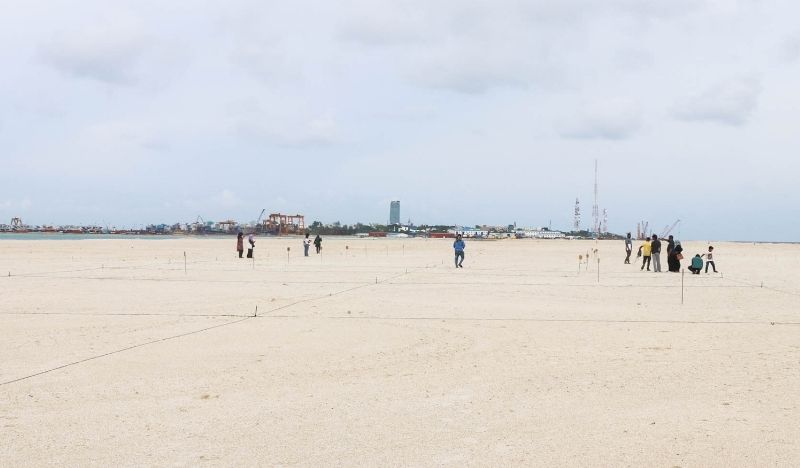
Over 160 Gulhifalhu plots distributed by ministry | Photo: Planning Ministry
Public Sector Investment Programme (PSIP) spending fell by MVR 1.31 billion year-on-year as of 8 October, despite a MVR 265.2 million increase in expenditure on land management, as the government continues major land reclamation and housing projects across the Greater Malé region.
According to the latest Weekly Fiscal Development updates release by the Ministry of Finance and Public Enterprises, Total PSIP expenditure stood at MVR 4.81 billion as of 8 October 2026, down from MVR 6.12 billion during the same period last year. Spending represented approximately 57.9 per cent of the MVR 8.31 billion approved budget for 2026.
advertisement

advertisement

Expenditure on land management under general public services increased from MVR 386.4 million in 2025 to MVR 651.6 million this year, marking an increase of MVR 265.2 million.
Other areas recording higher expenditure included primary and secondary education, where spending rose by MVR 290.5 million to MVR 386.8 million, and energy and utilities, which recorded an increase of MVR 217.6 million to MVR 257.7 million.
Spending on water and sanitation increased by MVR 112.6 million to MVR 253.4 million, while public housing expenditure rose by MVR 65.5 million to MVR 334 million. Healthcare infrastructure spending also increased by MVR 55.5 million to MVR 302.8 million.
However, the overall decline in PSIP expenditure was largely reflected in transport infrastructure, where spending fell by MVR 2.08 billion, from MVR 4.01 billion as of 8 October last year to MVR 1.93 billion this year.
Expenditure on climate mitigation and adaptation declined by MVR 177.3 million to MVR 55.3 million, while pollution control spending fell by MVR 86.8 million to MVR 98.5 million. Agriculture and fisheries expenditure decreased by MVR 81.3 million to MVR 64.6 million.
The spending figures come as the government pursues several major land reclamation and housing initiatives, including Ras Malé, Hulhumalé Phases II and III, Giraavaru Falhu and Gulhifalhu. These developments form part of efforts to expand land availability and provide housing, including through the Binveriyaa scheme.
Ras Malé is among the government’s largest ongoing reclamation projects. As of 25 August, 716 hectares had been reclaimed out of a planned 1,150 hectares, representing 62 per cent completion. The government has set a target of completing the reclamation by the end of 2026 and is preparing housing schemes for the area.
The government has also entered into a commercial terms agreement with UAE-based Eagle Hills to develop approximately 500 hectares of Ras Malé under the Maldives Waterfront and Marina project. The wider development is planned to include residential, commercial and tourism facilities, while the government has said the remaining area of Ras Malé is intended primarily for residential development.
In Hulhumalé Phase II, the government has continued to develop infrastructure and address land allocation needs, while reclamation of Phase III was completed in January. Under Binveriyaa, 698 plots were allocated in Phase III, with land handovers beginning in March. By September, 603 plots had been physically handed over and registry documents had been issued for 641 plots.
At Gulhifalhu, 3,548 plots were allocated under Binveriyaa. By 17 September, 1,393 plots, or 39.3 per cent, had been physically handed over, while registry documents had been issued for 3,086 plots. The ministry said some plots could not yet be transferred physically because the areas were being used for the Thilamalé Bridge project and other infrastructure developments.
Reclamation at Giraavaru Falhu resumed in January, with the project intended to provide additional land for housing and urban development. The government had initially allocated 2,000 plots there under Binveriyaa, but later revised the plan to accommodate essential infrastructure and services, offering applicants the option to transfer their allocation to Gulhifalhu.
While expenditure on land management has increased, the overall PSIP figures show that spending remains lower than at the same point last year, largely reflecting reduced expenditure on transport infrastructure and several environmental and resource-management categories.