September 2, 2026
Driven 'Senseless': Death After Death on the Roads




In a modern governance system like the Maldives, political parties are supposed to be the backbone of democracy. Every party climbs to power by selling a manifesto. Today, however, we are witnessing a grim reality: the power to shape party policies has been monopolised by a select group of political elites, driving a massive wedge between actual public needs and state policy. Turning a deaf ear to the genuine struggles of ordinary citizens, the political agenda is tailored strictly to serve upper-class interests. Projects are routinely prioritised simply to protect big businesses or to boost the popularity of specific politicians. From massive national ventures to small island projects, this obsession with safeguarding elite interests remains identical.
Influence and Policies Crafted for Corruption
Because influential elites hold the reins of political parties, party manifestos and national policies completely overlook the day-to-day realities of ordinary citizens. Instead, the priority is to shelter big business. Regulations and policies are systematically altered to benefit the wealthy tycoons who fund political campaigns—a prime example being recent amendments to commercial laws. Even the real motive behind the recent price adjustments on tobacco products remains heavily obscured.
Last year, this very government decided to levy an import duty of £0.41 (MVR 8) per cigarette, only to recently slash it back down to £0.21 (MVR 4). This U-turn is clearly driven by commercial interests. The government claims the duty reduction was out of public health concerns, arguing that skyrocketing prices drove people to consume unsafe, unregulated illicit tobacco alternatives.
However, the reality staring us in the face is that the initial hike created a massive black market, causing an explosion in smuggled cigarettes. In a country like the Maldives, riddled with legal loopholes and rampant corruption, this outcome was entirely predictable. As a result, the state revenue originally projected from these duties plummeted drastically.
The Obsession with Megaprojects
Massive concrete megaprojects offer great political theater. Crucially, they also make it incredibly easy to award contracts in ways that invite corruption and embezzlement. Consequently, the real issues—such as the fundamental needs for affordable housing, quality education, and an upgraded healthcare system—are buried and forgotten. Even in a sparsely populated country like the Maldives, there are still numerous islands without clean drinking water or proper sewerage systems.
In the 21st century, this is a reality that should deeply embarrass state authorities. Yet, instead of investing in these basic necessities, the government prioritises securing massive foreign loans to fund vanity megaprojects. No matter how eloquently these promises are phrased in party manifestos, when it comes to the implementation stage, megaprojects always trump basic rights.
Lavish Lifestyles and Disconnect from Reality
The elites who occupy policymaking positions live in an expensive, insulated world, far removed from the lives of ordinary citizens. While some ministers ride motorbikes to maintain an illusion of normalcy, the public is well aware of their immense wealth. A politician who rakes in hundreds of thousands in monthly rent or lives a luxury lifestyle funded by state perks cannot possibly comprehend the anxiety of a family crammed into a tiny, claustrophobic room.
Despite making endless promises to listen to the public during development campaigns, once in power, these officials gauge the state of the nation through the tinted windows of their air-conditioned cars. The result? The hardships of impoverished Maldivians and the crushing burden of inflation are wiped entirely from the political agenda. The rhetoric of top political party figures reflects this exact delusion. In their eyes, the public is thriving, goods are affordable, US dollars are plenty, and everyone is living a "happy" life.
The True Culprit Behind Centralisation and Migration to Malé
The economic evolution of the Maldives has seen its benefits overwhelmingly concentrated in one place. While every administration pays lip service to decentralisation, governments continue to dump the lion's share of the national budget into the Malé region. Massive infrastructure projects are exclusively concentrated around the capital.
While some disparity is expected given its status as the capital, is it fair to build bridges, skyscrapers, and paved roads in Malé while neglecting basic services on outer islands? How is it justifiable to reclaim vast tracts of land near Malé when thousands of people on outer islands lack the basic infrastructure for clean sanitation?
Government critics point out that instead of establishing vital services across the islands, the state is ploughing billions into non-essential projects in the Malé area. A primary example is the Fushidhiggaru Falhu (Rasmalé) reclamation project just south of Malé, which is costing billions of Rufiyaa.
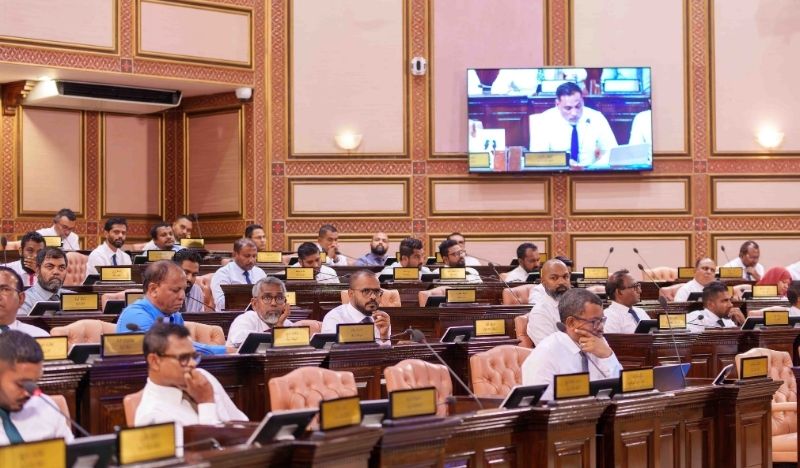
"This capital was born as 'Malé' using the money of all Maldivian citizens—the wealth of the entire country. Today, while the nation's foreign debt stands at nearly four billion dollars, roughly 90 per cent of that debt was incurred to develop this specific region [Malé] and expand this real estate market. Everything was stockpiled in Malé using the money of every single Maldivian," noted Dr Ahmed Shamheed, the opposition MDP MP for Hulhumálekula South, during a parliamentary session.
Dr Shamheed argued that the parallel market rate of the US dollar soared to MVR 21 precisely because the government forced unsustainable megaprojects, like the Fushidhiggaru reclamation, onto the budget. "The reality is that development projects across the outer islands have ground to a halt because of this," he added.
When in opposition, every politician sings the exact same tune as Dr Shamheed. However, the Maldives has witnessed administrations from both sides of the political divide, and when it comes to enforcing policy, their playbook is identical: congest Malé, make major decisions without checking the pulse of the people, and discriminate against the islands.
Even the Binveriya land-housing scheme, executed by the previous MDP administration to which Dr Shamheed belongs, followed this flawed blueprint. Sidelining the rights of thousands of people across the country, they handed out plots from scarce land in Hulhumálé and the wider Malé area—employing the very same centralised policies they now critique.
The Fallacy of Concrete Development
Policymakers seem to believe that building an airport, a harbor, and a few paved roads on an island solves everything. This is a complete delusion. Maldivians do not migrate to Malé because their island lacks an airport or a tarmac road; they abandon their homelands and squeeze into tiny rooms in the capital because their basic human needs are neglected.
There are still islands where residents must travel to Malé for minor ailments or routine laboratory tests because a reliable healthcare system does not exist. Opportunities for higher education and proper upbringing for children remain scarce on the islands.
Worst of all is the complete absence of economic opportunities and job creation. Because there are no projects that boost local productivity or generate employment, there are no livelihoods to be found at home or nearby. Consequently, islands are left abandoned as families are forced to migrate to Malé. Influential elites fail to grasp that concrete structures alone do not develop a community; true progress requires investing in human development.
The Path Forward
A solution will only emerge when the power to shape political party policies is handed back to the citizens, rather than being dictated by the empty promises of politicians. Policies must be liberated from elite self-interest and the heavy-handed influence of big business.
There is no way out of this crisis until leadership recognises that genuine national development is not measured by grand megaprojects, but by human resource capacity and the fulfillment of basic needs. Building three or four airports in every single atoll to chase votes or reclaiming land beyond the budget's capacity will never solve the real problems of the people.
The Maldives desperately needs a structured, logical priority list for development projects. This can only be integrated into party manifestos by genuinely listening to the public—and it can only be delivered by prioritizing the basic rights of citizens over political greed.