

The "Bodu Badhalu": Lacking Real Substan
ދިވެހި
August 8, 2026
The most pivotal shift in the Maldives’ political history took place during the 2008 presidential election. Marked by sweeping constitutional reforms, it was the first election in which political parties competed directly. Extensive efforts were made to communicate individual party plans and manifestos to the public. Among them, the Maldivian Democratic Party (MDP) promoted a vision unlike anything Maldivians had heard or dared to hope for before. That manifesto was rooted in fundamental rights the party had long advocated for, explicitly designed to improve the daily lives of ordinary citizens.
With the backing of a broader coalition, Mohamed Nasheed secured the presidency in 2008 and set about implementing the MDP manifesto. A wave of reforms followed to guarantee basic rights. Major transformations were introduced across social protection, decentralisation, state revenue generation, and governance frameworks. Although these sweeping shifts were difficult for some to digest at the time, they were undoubtedly bold decisions.
Once Again, Talks of "Change"
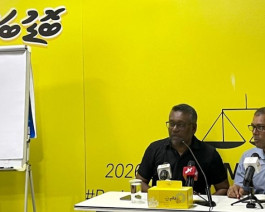
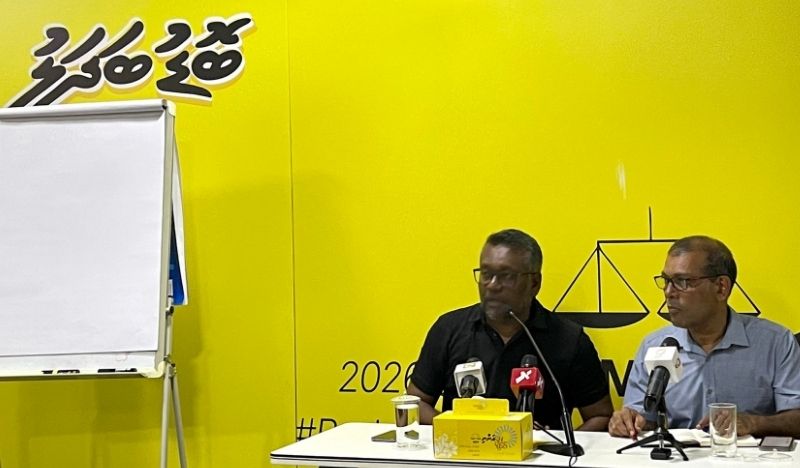
Looking ahead to the 2028 presidential election, former President Nasheed may not be running directly for the top office, but he remains firmly at the helm of the opposition. After the MDP’s leadership seemed adrift for a period, Nasheed and his core team reclaimed control of the party under a familiar banner of reform—this time branded as the "Bodu Badhalu" (The Big Change).
Unlike in the past, however, this iteration does not appear to prioritize the rights of ordinary citizens. Instead, critics view it primarily as a strategy to reclaim lost political power and influence.
Rather than offering a revolutionary blueprint tied to fundamental rights and everyday living standards, the proposals feel underwhelming and hollow. What is presented as state reform appears more like an effort to sustain party control. In practice, it looks like a calculated attempt to introduce features of the parliamentary system Nasheed has long advocated for, merely repackaged under a different name. Given the narrow path to regaining executive power via a direct popular vote, many believe this strategy is designed to consolidate control over state governance through alternative means.
Basic Rights Take a Back Seat
The "Bodu Badhalu" fails to present a clear roadmap for delivering tangible improvements to people's daily lives. It offers few concrete solutions to the country's most pressing contemporary challenges.
Key issues remain unaddressed, including:
Economic Pressure: No strategies to stabilise the rising US dollar rate, boost state revenue, or curb inflation.
Housing & Civic Reforms: A lack of solutions for the housing crisis, the permanent address issue affecting thousands in Malé, or constitutional and legal reforms needed for the electoral system.
Debt Management: No economic formula to escape the tightening trap of national debt. The framework offers no resolution for public debt, which stands at 129% of GDP and is projected to reach 140% in the medium term, nor does it outline ways to rebuild foreign reserves.
During Nasheed’s previous tenure, expenditure-cutting measures—such as salary reductions and structural downsizing—were unpopular with many, yet they ultimately yielded significant fiscal benefits for the nation. This time, rather than reining in spending, the early outlines of the proposal hint at a system that could prove even more costly than the current one.
Systemic Reform or Political Strategy?
At the core of the "Bodu Badhalu" are major structural proposals. These include separating the roles of Head of State and Head of Government, introducing recall votes, enabling votes to remove Supreme Court judges and commission members, reducing political interference in the judiciary, and establishing fixed timelines for referendums.
To many observers, this is simply Nasheed and his team paving the way to transition the Maldives from a presidential to a parliamentary system under a new label. Speaking at a recent event, Nasheed asserted that a presidential system is no longer viable for the Maldives. He noted that while the separation of powers was the most significant change introduced by the current Constitution, that objective remains unfulfilled 18 years on. In his view, a strict separation of powers is simply unattainable within a presidential framework in small states.
Nasheed highlighted that over the past four presidential terms, the party winning the presidency has consistently won a majority in Parliament as well, leading to a dangerous centralisation of authority.
"When a party secures a large parliamentary majority, independent institutions fall under the President's control. With such a strong majority in Parliament, even the judiciary comes under executive influence," Nasheed remarked, arguing that nothing stays static forever and that the Constitution must be re-evaluated.
Nasheed’s statements make it clear that his team’s primary objective for the upcoming election cycle is driving structural governance reform. However, he maintains that the "Bodu Badhalu" will yield practical, everyday benefits, insisting that household incomes can be raised through these structural shifts.
"I strongly believe that a constitutional change can bring about a major shift in family incomes. I have seen it, I know it, and I have experienced firsthand how past constitutional amendments led to increased income," Nasheed claimed.
Some observers suggest that because this is not yet a fully detailed manifesto, certain policy specifics may simply have been omitted for now. Nevertheless, if the goal is to win over the public, prioritizing a path to political power over practical solutions will not suffice. Unless the leadership can clearly demonstrate how these structural changes will directly raise household incomes and address the immediate economic challenges facing Maldivians today, the public will remain hard to convince.