


Azaan Defends Lawmakers’ Financial Struggles Amid Public Outrage Over Parliamentary Pay Rises
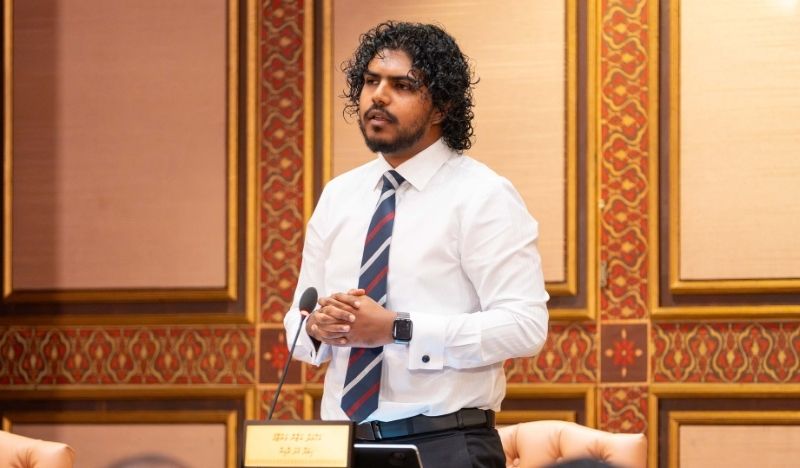
People’s National Congress (PNC) MP for Central Hithadhoo, Ahmed Azaan Marzooq, during a parliament session on May 12, 2026 | Photo: Parliament
Ruling People’s National Congress (PNC) MP Ahmed Azaan has defended lawmakers against accusations of excessive remuneration, arguing that Members of Parliament who lack secondary income streams frequently struggle to make ends meet due to high personal out-of-pocket spending on constituents.
Writing publicly on Facebook, the Central Hithadhoo MP asserted that comparisons between Maldivian legislators and international parliamentarians are fundamentally flawed, pointing out that foreign lawmakers receive dedicated statutory budgets for offices, staffing, and travel, whereas Maldivian MPs receive only their monthly take-home salary.
advertisement

advertisement

“MPs in the Maldives who do not have a secondary source of income often struggle to make ends meet by the end of the month. After covering basic living expenses and spending on constituents, there is very little left,” Azaan stated, adding that around 90 per cent of constituent requests he receives involve personal financial appeals, job-seeking assistance, or administrative favours.
Azaan argued that legislators in the Maldives are culturally pressured to sponsor island tournaments, community festivals, and school events, as well as finance constituency travel costing MVR 20,000 or more per trip entirely from their own earnings.
The defence has drawn sharp criticism from members of the public, with observers pointing out a stark shift in Azaan’s public positioning.
Prior to his election to parliament, during his career as a journalist and co-founder of the news outlet Dhiyares, Azaan had been a vocal critic of bloated state expenditures, high political salaries, and lavish parliamentary allowances.
Critics on social media were quick to highlight the contrast between his past advocacy against political privilege and his current defence of lawmakers’ remuneration.
However, the argument over secondary income highlights a unique feature of the Maldivian legislature. Unlike ministers and judges, Maldivian law does not prohibit Members of Parliament from owning private businesses, holding commercial assets, or earning private income while in office.
Consequently, the People’s Majlis comprises some of the wealthiest business magnates in the country.
Notable sitting legislators include Deputy Speaker Ahmed Saleem (Redwave Saleem), owner of the retail and wholesale giant Redwave, Sun Siyam Resorts tycoon and MDA leader Ahmed Siyam Mohamed, Villa Group chairman and Jumhooree Party leader Qasim Ibrahim alongside several other lawmakers with substantial commercial interests.
His defence comes amid intense public backlash following the Public Accounts Committee’s approval of a new MVR 22,000 monthly allowance for Speaker Abdul Raheem Abdulla, alongside allowance hikes for ministers’ drivers and island councillors.
The proposal to boost the Speaker’s pay was submitted by PNC MP Abdulla Shareef and supported by PNC MP Mohamed Mamdooh, who argued the measure rectifies an internal pay disparity.
Unlike ordinary MPs who take home MVR 82,500 and the Deputy Speaker who receives MVR 91,000, the Speaker does not sit on parliamentary committees and has been excluded from the standard MVR 20,000 committee allowance, earning MVR 73,125 per month.
The new allowance raises Speaker Abdul Raheem’s monthly compensation to MVR 95,125.
The committee additionally passed adjustments proposed by Mamdooh for ministers’ drivers, lifting their driving allowance to MVR 12,000, petrol allowance to MVR 2,000, and introducing a MVR 3,000 living allowance, bringing their monthly allowance total to MVR 17,000. Island council remuneration was also raised across all tiers through a flat MVR 5,000 service allowance, taking monthly pay to MVR 30,500 for council presidents, MVR 25,000 for vice-presidents, and MVR 23,000 for members.
The measures passed with the ruling PNC’s majority, drawing dissent from opposition Maldivian Democratic Party (MDP) MP Abdul Ghafoor Moosa, who condemned pay increases as unacceptable during difficult economic conditions.
Former Economic Minister and MDP Chairperson Fayyaz Ismail called the committee’s decision a “huge insult” to citizens facing high inflation and soaring living costs.
“Why do you think constituents need to ask you for money? Legislators have set up a system where the normal citizens have to beg and depend on legislators for even basic needs such as healthcare,” one citizen responded, adding that qualifications often mean little without political connections.
Another critic challenged the comparison to foreign parliaments, pointing out that Maldivian lawmakers had actively cultivated voter dependency through cash handouts and patronage.
“If MPs earning MVR 77.7k struggle, imagine ordinary citizens surviving on a fraction of that,” the response noted, contrasting parliamentary salaries with the statutory minimum wage, which caps civil service pay at MVR 7,000 and private sector salaries between MVR 4,500 and MVR 8,000.
“Perhaps these expectations have grown here because legislators themselves have normalised giving money, sponsoring events, and providing personal favours. You cannot keep normalising these practices and then complain about the burden. Stop the favors, end election handouts, and fix the system.”