

How 47% of the Vote Became 71% of Parliament
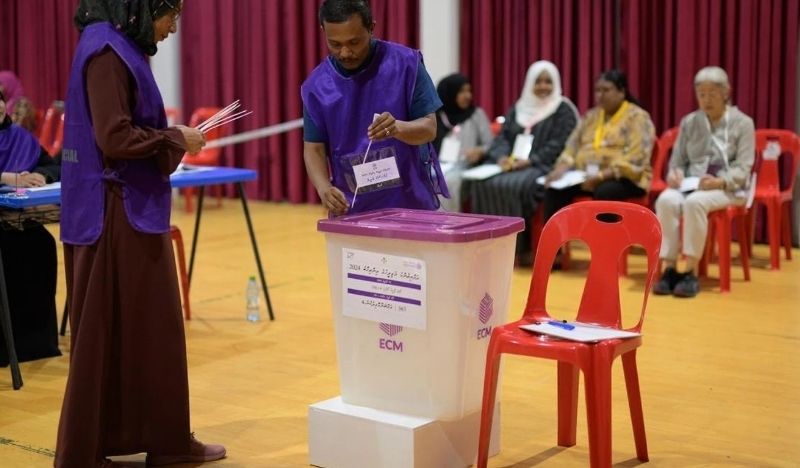
Photo: Elections Commission of Maldives
Maldives’ 2024 parliamentary election offers a closer look at how the country’s electoral system turns votes into seats, and why winning the most votes nationwide does not necessarily translate into an equal share of Parliament.
In April 2024, the People’s National Congress (PNC) secured a commanding majority in Parliament, winning 66 of the 93 seats contested. Yet the party received just 47.48 per cent of valid votes cast nationwide.
advertisement

advertisement

The Maldivian Democratic Party (MDP), meanwhile, received 30.74 per cent of the vote but won only 12 seats, or 12.90 per cent of Parliament.
How did one party turn less than half the national vote into more than 70 per cent of parliamentary seats?
The answer lies largely in how the Maldives elects its members of Parliament.
How First-Past-The-Post works
The Maldives uses a First-Past-The-Post (FPTP) electoral system, where the country is divided into constituencies, each electing one representative to Parliament.
Under this system, the candidate who receives the most votes in a constituency wins the seat. There is no requirement to secure more than 50 per cent of the vote.
Consider a constituency with four candidates. If one receives 38 per cent of the vote, another 31 per cent, and the remaining two receive 19 and 12 per cent, the candidate with 38 per cent wins.
This is despite 62 per cent of voters having supported someone else.
The system produces a clear winner in each constituency, but it also means that a candidate can be elected without the support of an absolute majority of voters.
Why votes and seats do not always match
In 2024, 212,979 valid votes were cast across the Maldives. Of these, PNC candidates collectively received 101,128 votes, securing 66 parliamentary seats.
MDP candidates received 65,476 votes but secured just 12 seats. Independent candidates collectively received 30,931 votes and won 11 seats.
The difference becomes even more apparent among smaller parties.
The Democrats received approximately 2.18 per cent of the national vote but failed to win a single seat. The Maldives Development Alliance (MDA), despite receiving a smaller share of the vote at approximately 1.91 per cent, secured two seats.
The Maldives National Party (MNP) won one seat despite receiving just 0.50 per cent of the national vote.
This happens because parliamentary seats are not distributed according to each party’s total national vote share. Instead, the result is determined separately in each constituency.
A party could receive thousands of votes across dozens of constituencies without winning any seats if its candidates consistently finish second or third.
Another party could receive fewer votes overall but win seats by concentrating enough support in particular constituencies.
This is one of the defining characteristics of First-Past-The-Post.
What happens to votes cast for losing candidates?
The 2024 parliamentary election had 368 candidates competing for 93 seats, averaging almost four candidates per constituency.
According to an analysis of the election, successful candidates collectively received an estimated 118,000 to 123,000 votes.
That suggests more than 90,000 valid votes were cast for candidates who did not win.
These votes were counted and contributed to the election results, but they did not directly translate into parliamentary seats.
This distinction matters because a constituency is represented by its winning candidate, regardless of how many residents voted for someone else.
It also helps explain how a party can secure a substantial parliamentary majority without receiving a majority of votes nationwide.
Does it take the same number of votes to become an MP?
Another feature of the Maldivian electoral system is the difference in the number of votes required to win a constituency.
The election analysis estimates that successful candidates received an average of around 1,250 votes each. However, that national figure hides considerable differences between constituencies.
In some smaller island constituencies, candidates secured parliamentary seats with fewer than 500 votes.
In densely populated constituencies in Malé, Hulhumalé and Addu, winning candidates could receive more than 1,600 to 2,000 votes.
Despite these differences, every elected MP holds one seat in Parliament and has the same voting power in parliamentary decisions.
This reflects the way parliamentary constituencies are drawn across the Maldives, where population size, geography and electoral boundaries all influence representation.
A question of representation
The issue of representation is not limited to how many votes candidates receive.
Transparency Maldives, in its 2024 Pre-Election Assessment, raised concerns about the way voters are assigned to constituencies based on their permanent registered addresses rather than where they actually live.
One example involves Dhaftharu voters.
For the 2024 parliamentary election, at least 9,653 Dhaftharu voters were allocated mainly across three constituencies: Villimalé, Hulhumalé Central and Hulhumalé North.
The allocation gave these voters a stronger collective voice in electing parliamentary representatives. However, Transparency Maldives noted that the constituencies may still not reflect where many of these voters actually live or have their main social and economic interests.
This raises a broader question about substantive representation: whether voters are electing representatives for communities in which they actually live and have a stake.
What does a parliamentary majority represent?
The 2024 election delivered PNC an overwhelming parliamentary majority, giving the ruling party considerable influence over legislation and parliamentary decisions.
But the result also demonstrates an important distinction between electoral support and parliamentary representation.
PNC’s 70.97 per cent share of parliamentary seats did not mean that 70.97 per cent of voters supported the party. Its candidates received 47.48 per cent of valid votes nationwide.
Neither figure is incorrect. They measure two different things.
One represents the proportion of valid votes received by a party’s candidates. The other represents the proportion of constituencies its candidates won.
Understanding that difference is essential to understanding how elections work in the Maldives.
The 2024 parliamentary election did more than determine who would occupy the 93 seats in the People’s Majlis. It also offered a clear example of how electoral rules shape political representation, and why the number of seats won does not always tell the full story of how a country voted.