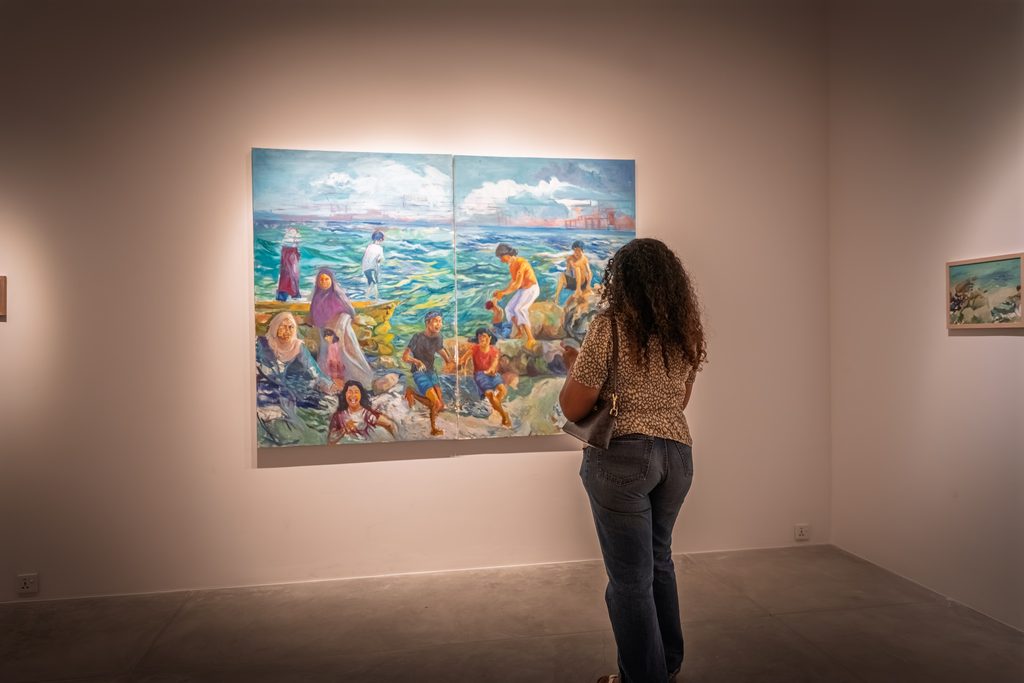

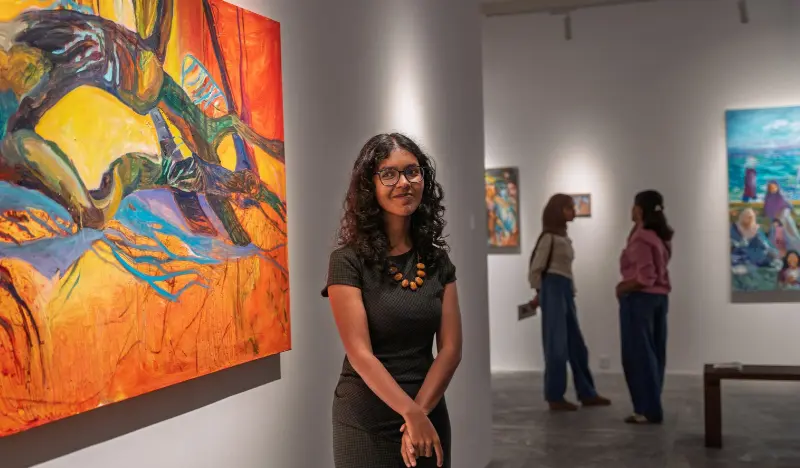
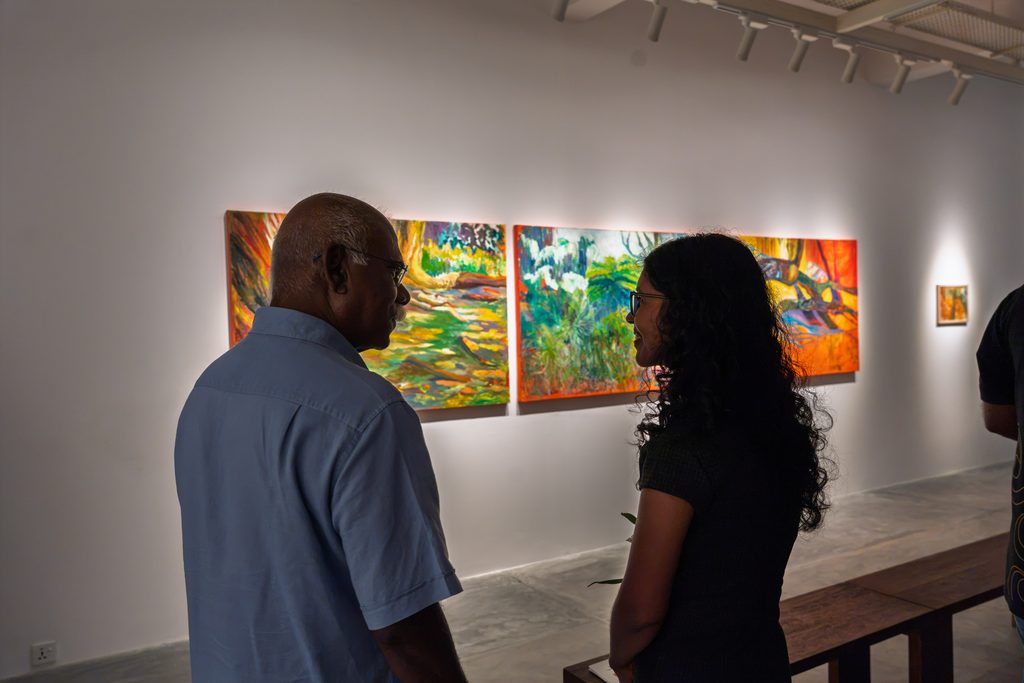
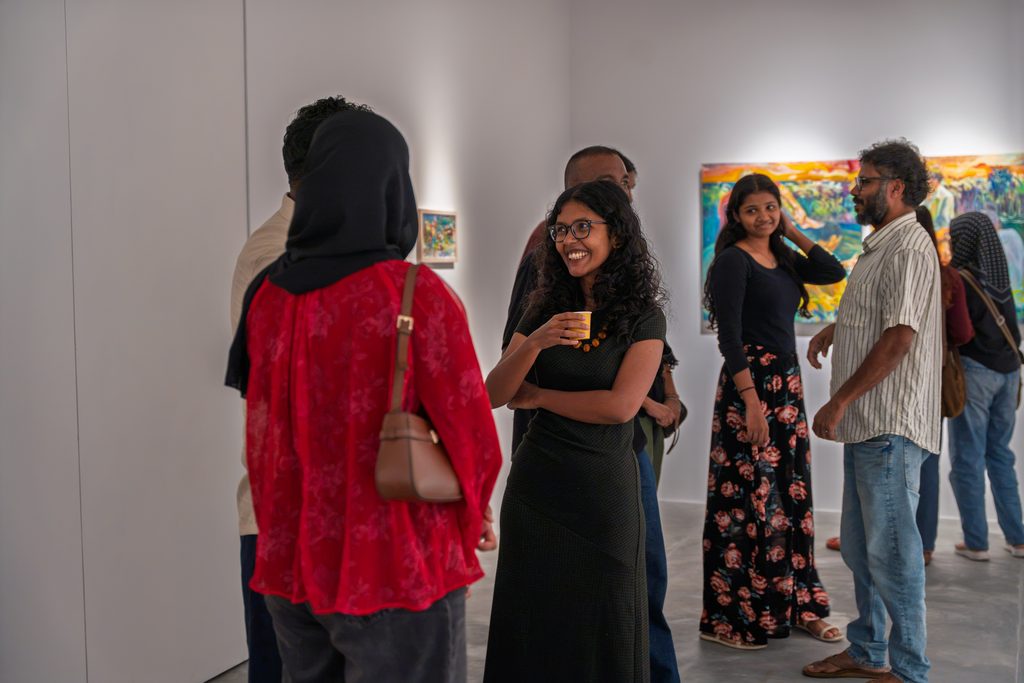
Change is what the paintings and the scenes in Reem Waheed’s The Sun Still Sets in the West exhibition revolve around. The paintings currently exhibited at Gallery 350 from 23 October to 30 November represent the 27-year-old artist’s keen observation of her surroundings and her interpretation of the bond between daily life and identity.
After completing her Diploma in Fine Arts at The One Academy in Malaysia, Reem’s return home to the Maldives two years ago brought her to a strange place. Construction sites had invaded the green and communal spaces she had once admired. Mammoth bridges now conceal the horizon from the western and eastern sides of the city she grew up in. And with these material changes, the most significant shift she observed was in how our society went about our day-to-day lives.
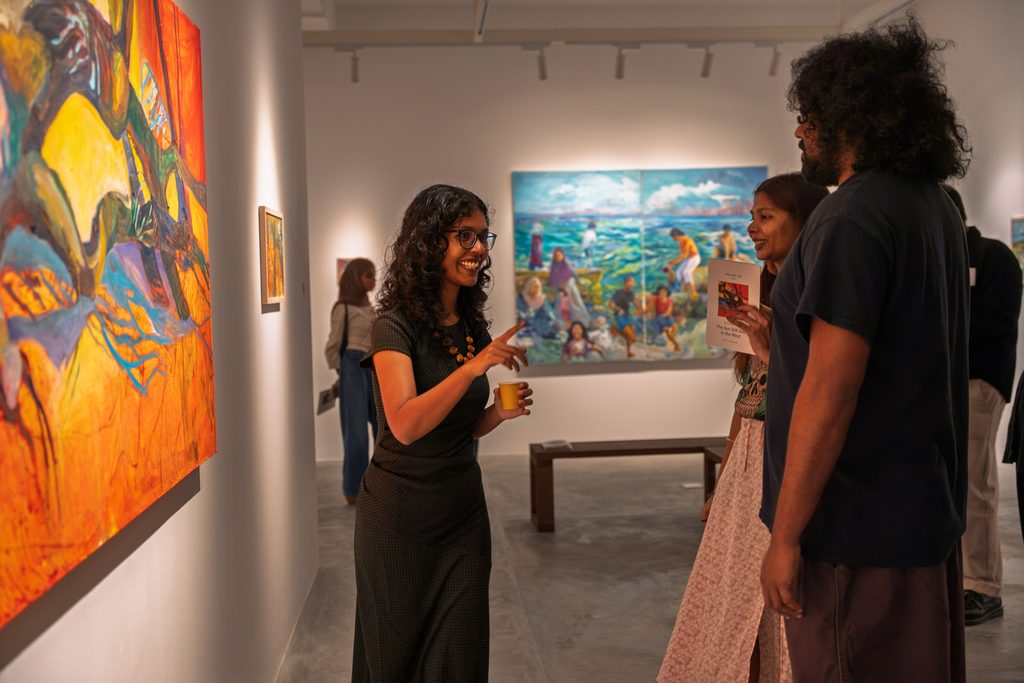
Painting from both memory and observations, each brushstroke an attempt to capture the fading remnants of our environment and society, Reem’s artistic exploration of these changes over roughly eight months brought about the series The Sun Still Sets in the West.
Parallel Streets and Everyday Observation
For Reem, the seeds of this exhibition were planted long before she stepped back onto Malé’s newly paved roads. Having started painting seriously in 2017, with small acrylic studies of the streets near her home, she eventually transitioned to oil painting.
While studying in Malaysia, an intensive academic schedule kept her indoors for much of the day. Determined to “always make sure painting is part of my daily activities,” she began documenting the fragments of life she glimpsed on her daily commute to college. Yet even as she painted Malaysian streetscapes, her mind remained tethered to home.
She painted parallel worlds, using the visual rhythm of Malaysian streets to recall what it felt like to walk through Malé. When she wasn’t painting her commute, she reached out to fellow Maldivians living in Malaysia, friends and strangers alike, asking to visit their homes and paint them in their own spaces.
“This is a continuation of what I was exploring even then,” Reem explains.
At The One Academy, switching from the commercial rigidity of illustration to a research- and conversation-driven fine arts program taught her to look beneath the surface. Under the mentorship of a Chinese-Malaysian lecturer whose own work grappled with political and cultural identity, Reem learned to translate heavy societal shifts with subtlety rather than aggression, leaving room on the canvas for viewers to bring their own memories into the frame.
Painting the Commute
Returning to the Maldives nearly two years ago, however, required a fundamental shift in her artistic territory. Previously focused largely on figurative works, Reem found herself confronted by an urban environment that felt almost unrecognizable. Even the act of commuting had transformed. Moving between her home in Hulhumalé Phase 1 and her workspace in Malé—working across multiple canvases simultaneously due to limited studio space—the commute once again became both her subject and her studio.
“Previously, you go to nature and things revolve around nature,” she observes. “Now, the streets are developed and nature comes around it.”
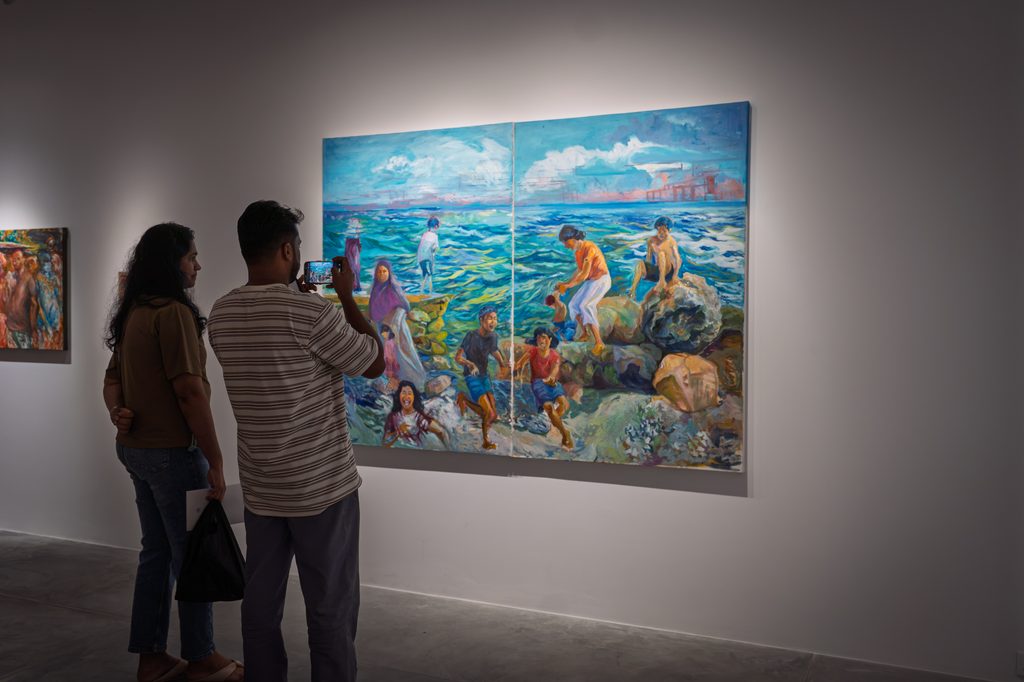
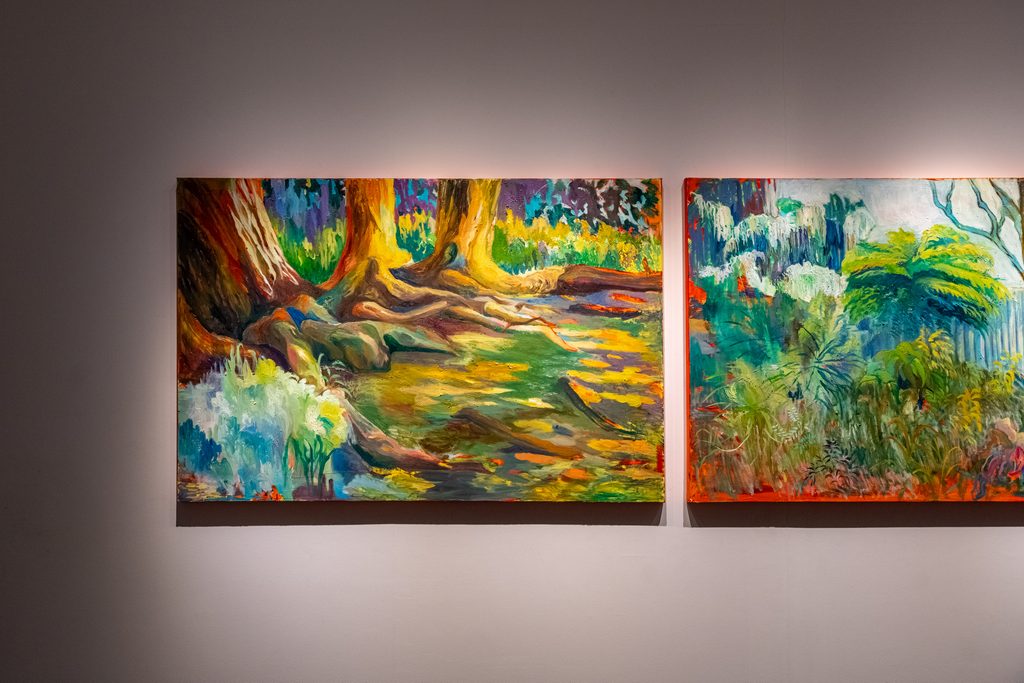
That inversion is captured in her painting of the approach to the Sinamalé Bridge, the exact spot where riders pause to put on their helmets, where tin construction sheets box in the road and greenery is pushed to the margins. Across her canvases, the bridge recurs on the horizon not merely as infrastructure, but as a quiet marker of transition. In Villingili, where she frequently accompanied her husband while he went on a project, Reem spent four-hour sessions painting on-site by the water, watching the distant silhouette of the bridge intrude upon an island once tied to childhood memories of her grandparents and traditional holhuashi seating.
Even her process resists the detachment of modern documentation. Refusing to rely on photographs, Reem paints from fleeting visual memory and emotional resonance.
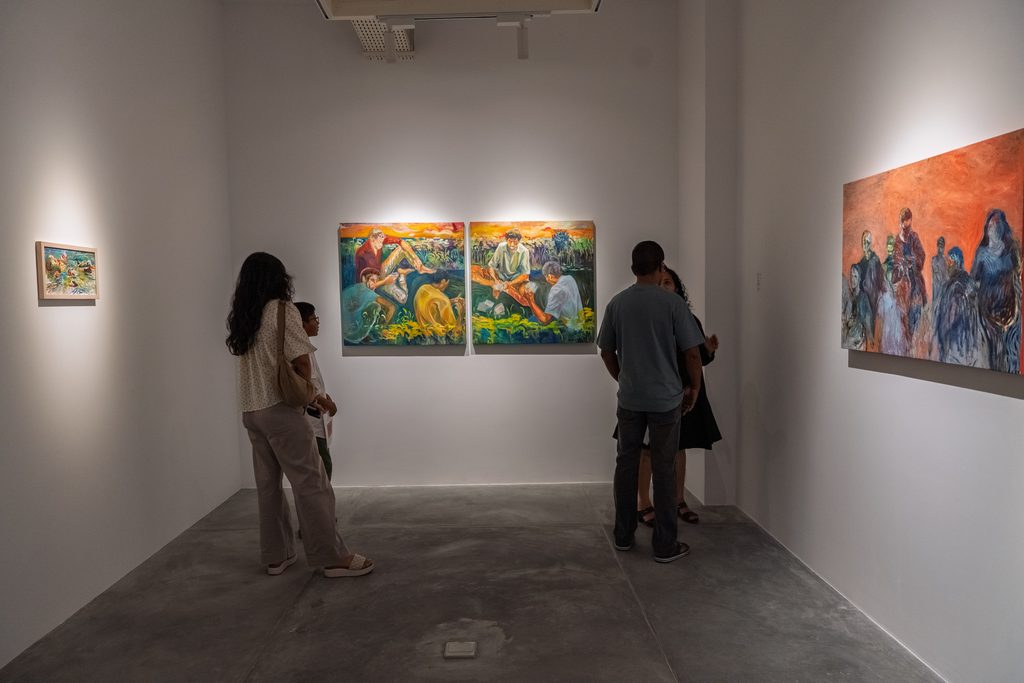
When she noticed a group of expatriate workers gathered on a pavement near Villa Fuel in Hulhumalé playing cards after work, she went home and had Izaan pose so she could reconstruct their posture and body language from memory, a role her husband embraces so often he calls himself her “easily available subject.”
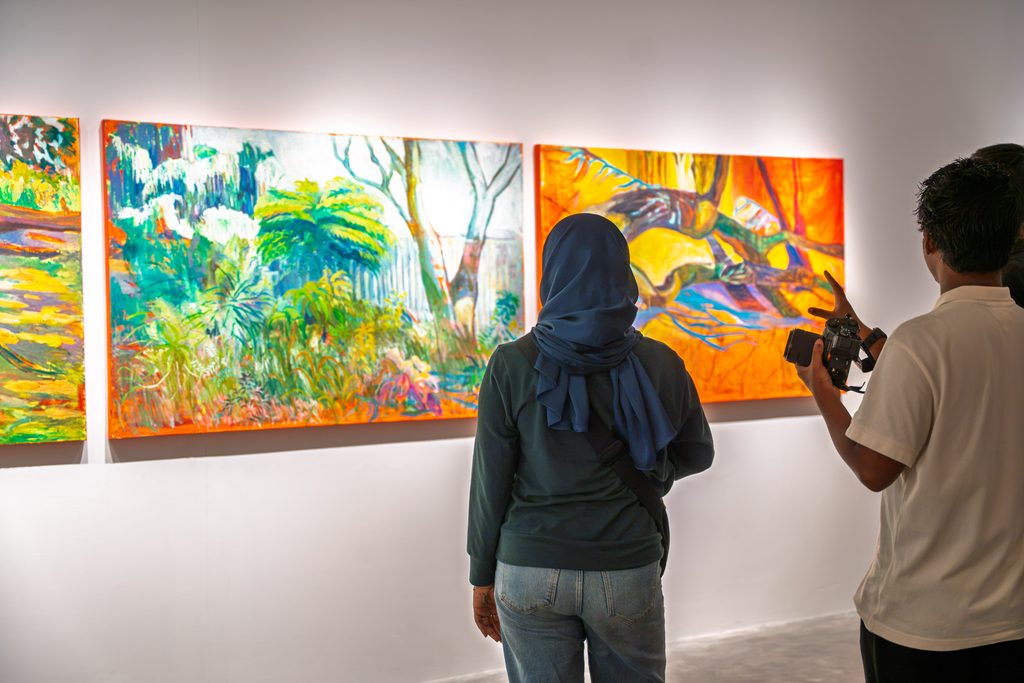
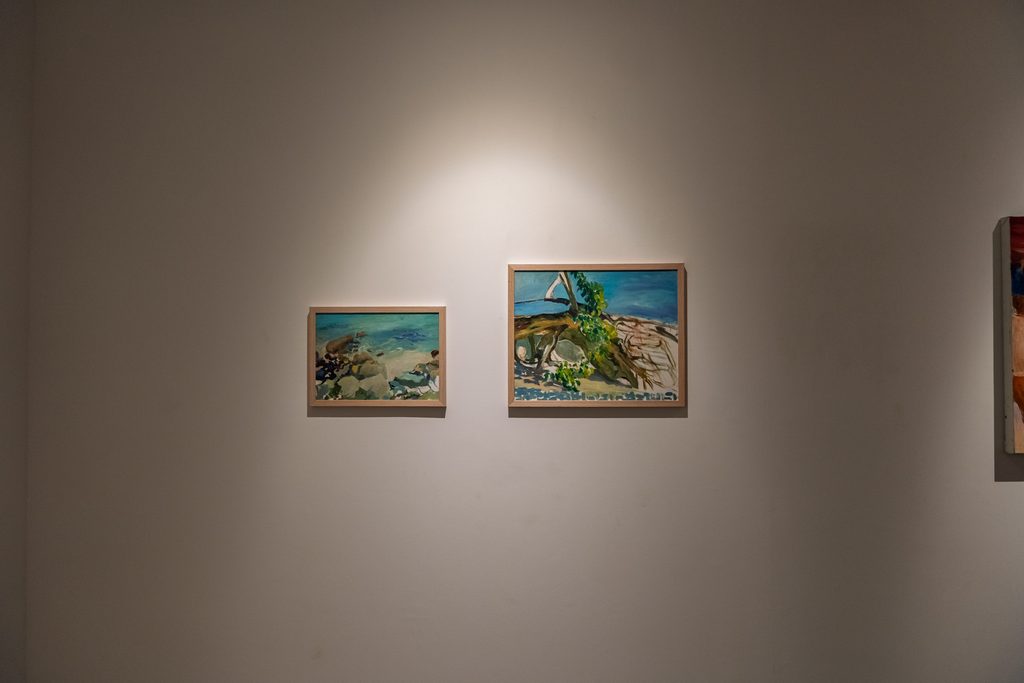
Rather than making tight pencil outlines, she sketches loosely with a brush, allowing intuition to guide the composition. Sometimes, meaning reveals itself only after the paint dries. On the exhibition’s opening night, a visitor pointed out the unexpected presence of red in one of her coastal studies—a hue rarely found in the Maldives’ natural seaside palette. Reem realized she had instinctively captured the rusted steel of nearby construction sites bleeding into the shoreline.
Honesty Over Detachment
Beneath Reem’s intuitive brushwork lies a strict personal ethic: she will not paint a place she has not physically inhabited and felt. For years, she avoided painting the sea altogether simply because she did not know how to swim.
“I think it’s dishonest if you’re not familiar,” she says.
It was only two years ago in Malaysia that she seriously learned to swim, and even during a brief stint working at a Maldivian resort, she spent her break times floating in the lagoon with a life jacket for an hour every day, studying the movement of the waves until she felt she had earned “permission” to put the sea onto canvas.
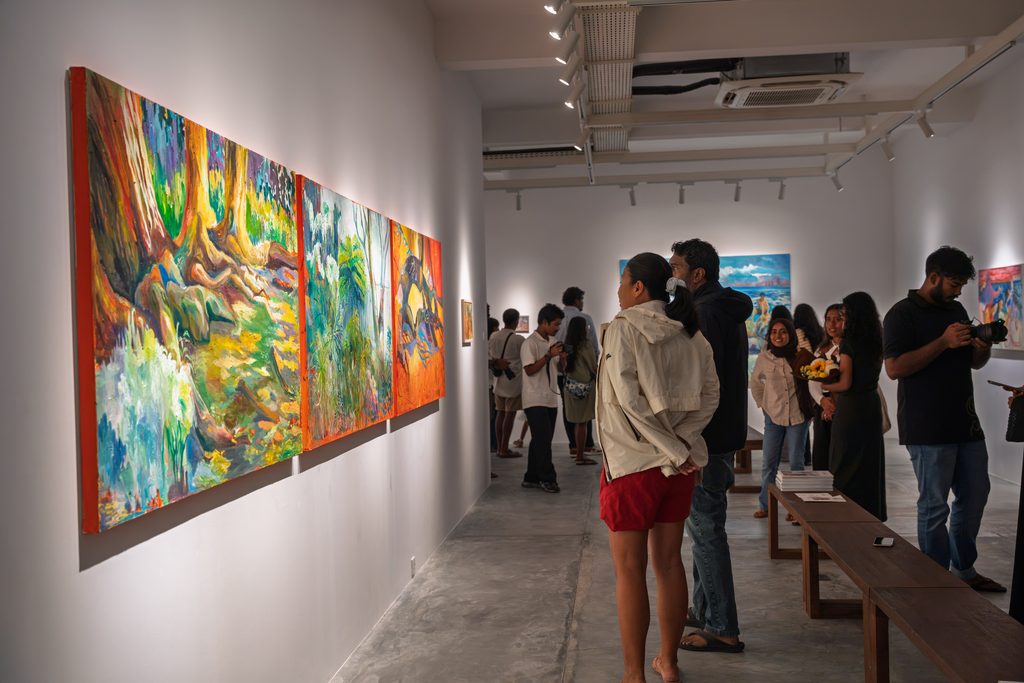
That same commitment to emotional honesty led her to paint over one of the exhibition’s major pieces four separate times. Originally, the canvas depicted a bustling figure in the middle of Hulhumalé Phase 2 against the backdrop of the bridge. Yet the scene felt forced. Because she does not live in Phase 2, she stripped away the invented activity, reshaping the work into a passive observation of changing horizons seen from a distance.
Tourism, Commercialisation, and Remembering Who We Are
When asked what external force has most shaped contemporary Maldivian art, Reem points not to a distant artistic movement, but to the country’s largest industry: tourism.
In a market driven by souvenir shops and resort walls, local artists face constant pressure to produce marketable products—pristine white beaches and swaying coconut palms tailored to foreign expectations. Having worked at a resort for three months before leaving during her probation period, Reem experienced firsthand how churning out palm trees for visitors can hollow out an artist’s curiosity.
“We forget to look at our own place in the mirror,” she says.
For many residents in Malé, where the horizon itself is increasingly blocked or inaccessible, those postcard scenes no longer reflect lived reality.
“Now, if you go to an island, the people who know the island more are not locals—they are the tour guides.”
To protect her creative autonomy from commercial compromise, Reem deliberately separates her livelihood from her art, working as a teacher rather than relying on commissions or commercial design. If someone connects with a finished piece and buys it, she welcomes it, but the canvas itself remains reserved for honest inquiry.
That inquiry, ultimately, is what gives The Sun Still Sets in the West its quiet urgency. As rapid urbanization and imported ideals reshape the physical and social landscape of the Maldives, Reem worries that a lack of connection to local history and environment leaves society unmoored. Yet the title of her exhibition carries an unmistakable note of hope.
“The sun still sets in the west—meaning there’s still time,” she reflects. “Even if things are changing, if you’re intentional, you can hold on to your identity. For me, painting helps ground myself. It’s just a reminder to know that there’s still time.”