September 2, 2026
Driven 'Senseless': Death After Death on the Roads




If someone achieves something worthwhile in the Maldives, people rush to take the credit—especially political leaders and parties. Even when an incumbent government completes a project, previous administrations scramble to claim ownership.
This has been the case for virtually every major development in the country. From airports and housing flats to roads and land reclamation, every initiative spanning more than one term follows the same script: as soon as a project is finished, everyone comes forward to claim it as theirs. But if things go wrong or suffer delays, the game immediately shifts to passing the buck.
The state of the economy is no different. When it comes to the vast loans taken out by the state, not a single government, politician, or party is willing to step up and take responsibility. Instead, they simply point fingers at one another.
Everyone Wants a Piece of the Ring Road
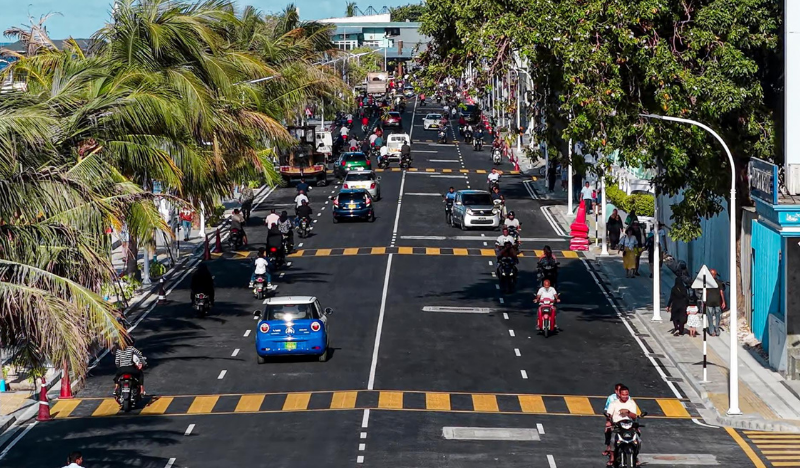
We are seeing this exact dynamic play out right now. The redevelopment and re-asphalting of Male’s ring road, Boduthakurufaanu Magu, has dragged across three separate administrations.
During former President Abdulla Yameen’s tenure, a section of the road was completed as part of the Sinamalé Bridge project connecting Malé, Hulhulé, and Hulhumalé. Under his successor, Ibrahim Mohamed Solih, asphalt was laid not on Boduthakurufaanu Magu itself, but on its most critical artery, Ameenee Magu. That work remained unfinished by the end of Solih's five-year term, and was ultimately completed under the current president, Dr Mohamed Muizzu.
However, sections built during the current administration soon deteriorated and are now being redone. The current government blames the previous administration for poor quality, while officials from the former administration insist the damage was caused by rushing the work just to meet deadlines. Once again, nobody takes ownership; they just trade blame.
That said, upgrading Boduthakurufaanu Magu remains a top priority for the present government. So far, two of Malé’s busiest areas—the local market zone and the area surrounding the Bank of Maldives head office—have been widened and repaved with asphalt. These improvements have noticeably eased traffic congestion, earning the government widespread praise.
Yet, as soon as photos of the newly paved roads circulated, figures close to former President Yameen stepped in to claim credit. They argued that comprehensive designs for the road’s redevelopment—including a proposed flyover—had already been finalised before Yameen left office. They claim the current administration merely tweaked those plans, adding that had Yameen won a second term, the road would have turned out far grander and more functional.
Maldivians, naturally, turned to social media to take the political back-and-forth with a pinch of salt. Soon, AI-generated concept art began circulating online, visualising wildly ambitious designs for Malé: multi-tiered elevated highways, floating roads, and dedicated harbours for luxury yachts and cruise liners.
When the Debt Mounts: "Not My Problem!"
While politicians race to take the glory for visual successes, not a single leader, government, or party is willing to take responsibility for the country’s precarious economic position or its astronomical debt.
The Maldives' external debt did not cross the MVR 100 billion mark under a single president. It is the cumulative result of successive administrations borrowing heavily over many years. Economically speaking, taking on debt is not inherently bad—it is often necessary to finance large-scale infrastructure. However, debt must be managed prudently. Without proper oversight, a country risks severe economic decline or even insolvency, which closely mirrors the situation the country faces today.
Whenever the national debt is raised, incumbents invariably blame their predecessors. The current government points the finger at the former Maldivian Democratic Party (MDP) administration. The MDP counters that its borrowing was essential to manage the fallout of the COVID-19 pandemic, maintaining that the root of the crisis lies in President Yameen’s tenure. They point to unsustainable mega-projects and wasteful spending, including the Sinamalé Bridge, the 25-storey Dharumavantha Hospital, the 7,000 housing units, and the Velana International Airport expansion—projects funded through Chinese loans and grants that MDP claims yielded questionable financial returns for certain political figures. The MDP also argues that uncollected state revenues from island leases during Yameen’s term heavily contributed to the strain.
Conversely, the current administration places the blame squarely on Solih’s government, arguing that the previous administration cannot simply hide behind COVID-19 as an excuse. The government notes that it is now burdened with paying off those very debts, with nearly $1 billion due this year alone. While a significant portion has been settled, the present administration continues to borrow. To service existing obligations, it has increasingly relied on internal debt—withdrawing from the pension fund, tapping into the Sovereign Development Fund (SDF), and issuing bonds. These measures continue to weaken the economy, contributing to a persistent foreign exchange shortage.
Responsibility?
The Maldives is a nation with limited natural resources. Its economy relies almost entirely on revenue from tourism and related industries. The state simply does not generate enough income to cover its massive public sector wage bill alongside major infrastructure development, making borrowing unavoidable.
The problem is that debt must be managed sustainably. Too often in the Maldives, loan-funded projects fail to yield direct economic returns. As a result, the infrastructure built does not generate the revenue needed to service the loans that paid for it.
Every incoming administration prioritises short-term public pleasing over fiscal reality. Building multiple airports within a single atoll might be politically popular, but it does not expand the tax base. Instead, it creates a recurring financial drain: costly infrastructure that requires ongoing maintenance and staffing without bringing in meaningful revenue.
When borrowing prioritises political promises over projects that generate foreign currency—such as transhipment ports or high-value resort developments—the public purse suffers the consequences.
Roads need asphalting, and ambitious infrastructure plans deserve to be brought to life. But if political leaders are eager to step into the spotlight for the photo opportunities, they must also be willing to stand up and take responsibility for the debts incurred along the way.