

Spending Billions on Rent: Why Does the State Refuse to Build Its Own Offices?
ދިވެހި
September 26, 2026
I stepped into the former Star Cinema building in Maafannu after a friend asked me to drop by for a coffee. As I entered the building and headed towards the lift, my eyes caught a black display board listing all the offices housed inside. In large letters were the names of the Auditor General’s Office, HRCM, BML, and several other entities. I thought to myself, "The owner of this building must be receiving a substantial amount from the state treasury every month."
While millions flow into the pockets of a select few in Male' to run state offices, why is the government unable to construct its own office buildings? What is the government losing? Why, under the influence of a powerful few, does a set amount from the state treasury systematically enrich specific individuals?
The day came when dilapidated structures like Huravee Building and Gaazee Building had to be evacuated and demolished. Yet, by the time those two structures, which housed numerous government offices, were brought to the ground, the government had failed to construct another central building besides Velaanaage. On that day, the government was forced to move into properties owned by a few wealthy individuals in Malé, paying whatever high rent they demanded.
High Rents Exceeding Government Benchmarks
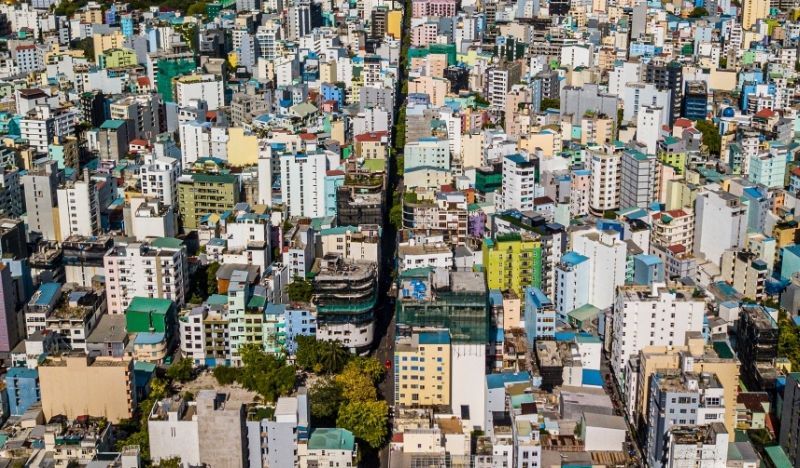
According to information obtained under the Right to Information Act, the state spent MVR 161.52 million in 2025 alone on renting office spaces. Furthermore, while the 2026 budget allocates MVR 92.5 million across 97 spaces for 32 institutions, MVR 87.8 million of that total goes directly to 46 buildings in Male'. In addition, MVR 53.2 million is spent annually on embassies abroad.
The budget document further reveals that although the government’s established benchmark for office rental is MVR 400 per square foot, the annual rent for 22 office buildings exceeds this standard. According to published statistics, these 22 buildings alone cost approximately MVR 64.2 million annually, representing roughly 73 per cent of the total rent paid for properties leased in Male'.
All these figures highlight the heavy burden the state carries in renting office space, as a large portion of the government budget is consumed by a small number of high-cost properties.
From the perspective of public finance and accountability, it is vital to examine the contract terms, guidelines, and procurement processes behind these high-value leases. Assessing whether rental expenditures offer value for money requires evaluating factors such as location, size, building condition, accessibility, lease duration, and the availability of alternative properties in the market.
Yet, the government today has failed to disclose any of this information. It appears as though the primary duty of the state is to safeguard the interests of the few individuals involved in these transactions.
Some individuals have amassed enormous wealth by leasing buildings to the government at inflated rates, accumulating fortunes so substantial that even their grandchildren may never need to work. Entire business empires have been built around this guaranteed income stream. There is no shortage of Maldivians living comfortable, luxurious lives abroad, funded entirely by rent received from government leases. All of this directly impacts the public interest and the living standards of ordinary Maldivian citizens.
The Unmet Demand for Dedicated State Buildings
Previous administrations made some attempts to address this issue. For instance, the Omar Zahir Building was constructed in Hulhumalé at a cost of MVR 185 million, aiming to provide some relief to the state budget. However, no permanent solution was achieved, and state spending on rent continues to rise. Subsequent governments have shown little inclination toward constructing additional office buildings, with no new projects announced. While cost-reduction policies frequently make headlines, not a single foundation stone has been laid to reduce office rental expenses.
Although the Umar Zahir Office Building was built in Hulhumalé, it does not provide sufficient space for government administration. The design of the building itself reflected no broader vision for resolving the overall problem. Of its four office floors, each offers 25,000 square feet of space, alongside parking facilities and dedicated event areas. It was originally designed to house the Ministry of Transport and Civil Aviation, the Ministry of Gender, Family and Social Services, and the Ministry of Higher Education. While the Gender and Transport ministries moved in, followed by preparations for Higher Education, this accounts for only a fraction of government offices. Meanwhile, numerous independent institutions and state-funded offices continue to operate out of private residential properties.
The six-storey government office building in Hulhumalé was officially opened in February 2023. Opening the facility, then-President Ibrahim Mohamed Solih noted that renting office spaces posed a major burden on the state budget and expressed confidence that the building would provide relief.
However, no reduction in state rental expenditure materialized. Instead, statistics show that spending increases day by day. Every year, the state spends enough on rent to construct multiple such buildings
.
Questions Surrounding Lease Agreements and Oversight
When leasing private properties, the government is required to abide by state finance and procurement regulations. Finance Ministry procurement records indicate that office space leases have been conducted through national competitive bidding processes. Nevertheless, past events raise serious questions about whether these rules are consistently followed. Indeed, some individuals construct large buildings with the explicit intention of leasing them to the government.
In late 2024, a corruption network involving high-ranking officials within the state came to light surrounding the creation of a television channel. A case surfaced where Maldives Media House, operator of 'MMTV', which is said to have ties to President Dr Mohamed Muizzu, sublet three floors of Sirageege (which it had leased) to NSPA. This sparked allegations of misuse of public funds. Yet, allegations were all that remained; no concrete action was taken, no individuals were held accountable, and public interest was ignored. Aside from terminating the lease agreement following public criticism, no further action was taken.
The overarching question remains: while spending billions, why doesn’t the government build its own office facilities? To build public trust in state property leases, it is essential to publish a central, public registry detailing all rented buildings. This registry should include the occupying institution, property area, annual rent, cost per square foot, lease duration, procurement method, and agreement expiry date.
This issue has persisted through every presidential term. With little effort made toward a lasting solution, it is clear that only a select group continues to benefit. Had the government invested in constructing its own facilities, billions of rufiyaa could have been saved for the state.